What Does It Really Mean for a Child to Be a Safe Swimmer?

“Does your child know how to swim?”

It sounds like a simple yes-or-no question. For many parents, the answer is yes if their child can jump into a familiar pool, paddle a short distance, or get back to the wall without help.

Those are meaningful accomplishments. However, they do not always provide a complete picture of a child’s ability in the water, and certainly does not necessarily mean “water safe”.

Can the child float independently? Can they tread water? Can they control their breathing? What happens if they enter the water unexpectedly or cannot touch the bottom? Can they swim far enough to reach an exit without becoming exhausted? Are they a strong enough swimmer to overcome the weight of clothing and shows should they fall in unexpectedly?

A child who can move through a backyard pool has developed basic swimming ability. A more capable swimmer can combine breathing, floating, body control, endurance, technique, and good decision-making in a wider range of situations.

Understanding that difference can help parents identify the skills their child already has and the ones they still need to develop.

“Can Your Child Swim?” Is More Complicated Than It Sounds

Swimming ability exists on a spectrum.

One child may be comfortable jumping into the shallow end but struggle when they cannot stand. Another may be able to swim underwater but have difficulty floating on their back. A child might cross a small pool using an inefficient paddle but become tired quickly in deeper or unfamiliar water.

Each of these children can swim in some capacity. That does not mean they are water safe.

Rather than only asking themselves a child can swim, parents should consider more specific questions such as:

These questions reveal much more about a child’s comfort, control, and overall water safety competence.

Basic Swimming Ability vs. Water Safety Competence

Basic swimming ability usually means that a child can move through the water under familiar and controlled conditions. That is an important stage of learning, but water safety competence goes further.

Water safety competence involves using several physical and decision-making skills together. A more water safety-competent swimmer may be able to:

The American Academy of Pediatrics describes water safety competency as the ability to get out of the water when someone enters unexpectedly. It also recommends looking for programs with experienced, well-trained instructors that teach both swimming and water-safety skills.

No single skill makes a child safe in every aquatic environment. Instead, children become more capable by developing multiple skills and learning how to use them together.

Nine Questions That Reveal More Than “Can Your Child Swim?”

Parents can use the following questions to take a closer look at their child’s current swimming ability.

1. Can Your Child Enter the Water and Return to the Surface?

Swimming does not always begin with a calm push from the wall. A child could slip from a pool step, fall from a dock, or enter the water more quickly than expected.

A capable swimmer should learn how to:

Practicing controlled entries helps children become more comfortable with the transition from land to water.

2. Can Your Child Float Independently?

Floating gives a swimmer an opportunity to rest, breathe, and regain control.

Some children learn to move forward before they become comfortable lying still in the water. They may be able to paddle briefly but panic when they become tired.

Back floating is especially valuable because it allows the swimmer to keep their face out of the water while using less energy than continuous forward swimming.

A child should gradually learn to:

Floating may look simple, but it requires trust, balance, breath control, and body awareness.

3. Can Your Child Tread Water?

Treading water helps a swimmer remain in one place without holding onto the wall or standing on the bottom.

This skill can be useful when a swimmer needs time to:

The amount of time a child can tread water will depend on their age, experience, technique, and endurance. The goal is not to reach an arbitrary number immediately. The goal is to develop increasingly efficient control so the child does not exhaust themselves unnecessarily.

4. Can Your Child Control Their Breathing?

Breath control is about more than seeing how long a child can remain underwater.

Long breath-holding contests should not be treated as a measure of swimming safety. Instead, swimmers should learn how to inhale at the appropriate time, exhale into the water, and maintain a consistent breathing pattern while moving.

Useful breathing skills include:

A swimmer who cannot coordinate their breathing may become tired or anxious even if their arms and legs are moving effectively.

5. Can Your Child Swim to the Wall Without Assistance?

Children should learn to identify the nearest safe exit and move toward it.

In a backyard pool, the wall may only be a few feet away. In a larger pool, the swimmer may need more endurance and better technique to reach it.

Parents can consider whether their child can:

The ability to reach an exit is more informative than whether a child can perform a short, rehearsed swim directly toward a waiting adult.

6. Can Your Child Exit the Pool Independently?

Reaching the wall is important, but the swimmer must also know what to do next.

Depending on their age and size, children can practice:

Exit skills should be practiced alongside entries so children understand the complete process of getting into and out of the water safely.

7. Can Your Child Remain Calm When They Cannot Touch the Bottom?

Some children appear confident as long as their feet can reach the pool floor. Their behavior may change quickly in deeper water.

A child who is dependent on standing may:

Lessons in appropriately deep water can help swimmers learn to trust their skills instead of depending on the pool floor.

This does not mean children should be pushed into deep water before they are ready. Experienced instructors introduce greater depth gradually while providing structure, support, and clear expectations.

8. Can Your Child Swim Without Goggles or Flotation Devices?

Goggles can make lessons more comfortable and help swimmers see underwater. They are a useful piece of swim equipment, but children should gradually become comfortable if their goggles leak or fall off.

Similarly, inflatable arm bands, pool floats, and other toys should not be confused with swimming ability. A child who can move confidently while wearing a flotation device may not respond the same way without it.

Children should learn that:

A child’s skills should not disappear completely when a familiar piece of equipment is removed.

9. Does Your Child Understand the “Rules” and Their Own Limits?

Water safety involves judgment as well as physical ability.

Children should learn to:

Confidence is valuable, but it should grow alongside respect for the water. A swimmer who overestimates their ability may take risks they are not prepared to manage.

Does a Safe Swimmer Need to Know Every Stroke?

A child does not need a competition-ready butterfly stroke to develop meaningful water-safety skills.

Floating, treading water, breath control, body position, forward movement, changing direction, and reaching an exit are more directly connected to practical water competence.

Knowing a safety stroke such as the elementary backstroke where a simmer can rest but also propel themself is crucial. Learning multiple strokes provides important benefits as well.

Freestyle, backstroke, breaststroke, and butterfly teach swimmers different ways to coordinate their bodies and move through the water. Continued stroke development can improve:

Proper technique also helps swimmers conserve energy. A child who relies on an inefficient paddle may be able to cross a small pool, but that same movement may not work over a longer distance.

Stroke development should therefore be viewed as part of becoming a stronger and more adaptable swimmer, even though mastery of every competitive stroke is not the sole definition of water safety.

Familiar Pools Can Create a False Sense of Confidence

Children often perform best in places they know.

They may know where the steps are, which areas are shallow, how far they must swim, and where a parent usually stands. That familiarity can make their swimming ability appear stronger than it would in a different environment.

Conditions can change at:

Open water introduces additional concerns such as currents, waves, limited visibility, uneven surfaces, changing temperatures, and longer distances to an exit.

A child should never be expected to handle every aquatic environment simply because they can swim across a familiar backyard pool.

What If a Child Can Swim but Tires Quickly?

Endurance is an important part of swimming ability.

A child may understand the mechanics of a stroke but lack the stamina to continue using it over a longer distance. When swimmers become tired, their technique may deteriorate. They may lift their heads, shorten their kicks, stop exhaling correctly, or begin to panic.

Building endurance does not mean pushing children until they are exhausted. It means gradually helping them:

Consistent lessons allow endurance to develop alongside technique rather than expecting a child to rely on effort alone.

How Hudson Valley Swim Develops Safer, More Capable Swimmers

At Hudson Valley Swim, learning does not stop when a child can move from one side of a small pool to the other.

Our curriculum helps swimmers build skills progressively based on their age, comfort level, and demonstrated ability. Depending on the swimmer’s level, instruction may include:

Lessons remain fun and encouraging, but activities are connected to measurable swimming or water-safety skills.

Small classes also allow instructors to observe how each swimmer performs. A child may be strong in one area while needing additional help with floating, breathing, endurance, or confidence in deeper water.

That individualized feedback helps families understand what the swimmer has mastered and what should come next.

Swim Lessons Are One Layer of Water Safety

Even strong swimmers require supervision.

The Centers for Disease Control and Prevention explains that formal swimming lessons can reduce drowning risk, but children who have taken lessons still need close and constant supervision around water.

A complete family water-safety plan may include:

No swim school should describe a child as drown-proof. Water conditions, fatigue, injury, clothing, temperature, and unexpected circumstances can affect even an experienced swimmer.

The goal of lessons is to help children become more comfortable, capable, knowledgeable, and prepared while families continue using every available layer of protection.

Is Your Child a Safe Swimmer?

There is no single test or skill that makes a child completely safe around water.

Instead of relying on a yes-or-no answer, consider the full picture:

If some answers are no, that does not erase the progress the child has already made. It simply identifies what they should learn next.

Find Out What Your Child Is Ready to Learn Next

A child who can paddle across the pool has reached an exciting milestone, but it may be only the beginning of their swimming journey.

Continued lessons can help transform basic swimming ability into stronger technique, greater endurance, better judgment, and increased confidence in a wider range of situations.

Explore our swim lesson programs and find your nearest Hudson Valley Swim location to discover how we help children become safer, stronger, and more capable swimmers.

Choosing a Swim School: What Parents Should Compare

Choosing a swim school is about more than finding the closest pool or the most convenient class time. Instructor experience, teaching techniques, class size, hidden costs, available programs, and the overall learning environment can all affect how a swimmer feels in the water and how steadily they progress.

Many large swim school chains operate dedicated, highly branded facilities with standardized teaching systems designed primarily for young children where instructor experience is not critical. These programs may offer colorful surroundings, consistent lesson formats, and a recognizable experience across multiple locations.

Hudson Valley Swim takes a different approach. By offering lessons in established partner pools and prioritizing experienced instructors, small classes, skill-based activities, and measurable development, Hudson Valley Swim creates an environment where swimmers of different ages and abilities can enjoy their lessons while making meaningful progress.

Both approaches can teach important swimming and water-safety skills, but the experiences and results they provide may be very different. The right choice depends on the swimmer’s personality, the family’s goals, and the type of environment in which that individual learns most effectively.

Pool Environment: Highly Themed or More Focused

One of the most noticeable differences between swim schools is the environment surrounding the lesson.

Many large swim school chains operate dedicated aquatic centers designed specifically for children. These facilities may include colorful decorations, branded characters, family changing areas, and a busy, energetic atmosphere. Many classes may take place in small roped-off sections of the pool at the same time, with noise from many instructors teaching, children splashing, and families moving throughout the facility.

Some children are unaffected by this level of activity. Others may find it difficult to hear instructions, maintain focus, or become comfortable with an unfamiliar skill when there is considerable movement and sensory input around them.

Hudson Valley Swim typically offers lessons in established partner pools inside community centers, health clubs, hotels, schools, and similar facilities. Although every partner pool is different, these locations often provide a more streamlined atmosphere with fewer visual and audible distractions surrounding the lesson.

A focused environment does not mean lessons are overly serious or rigid. Hudson Valley Swim instructors use encouragement, games, toys, and positive interaction to keep swimmers engaged. The fun takes place within the lesson itself and supports what the swimmer is learning.

This type of environment may be especially helpful for:

The goal is to create an environment where swimmers can enjoy being in the water, connect with their instructor, and concentrate on developing new skills.

Instructor Experience and Training

A knowledgeable and encouraging instructor can have a major influence on how a swimmer feels about the water.

Many national swim school chains use standardized training systems to create a consistent teaching structure across their locations. This can make it possible to prepare instructors to deliver a defined curriculum using established lesson plans and activities.

Hudson Valley Swim differentiates itself by emphasizing experienced instructors who typically bring at least three years of swim-instruction experience. Instructors may also have backgrounds in competitive swimming, coaching, education, or aquatic safety. Many hold lifeguard, Water Safety Instructor, First Aid, CPR, AED, and other relevant certifications.

Hudson Valley Swim instructors also complete training in the company’s proprietary curriculum. This includes online learning, co-teaching, and supervised instruction until they demonstrate proficiency. Training continues through in-service sessions and additional courses as new educational materials become available.

This combination of prior experience and continued training helps instructors understand that swimmers do not all respond to the same teaching style.

One child may need reassurance before attempting a new skill, while another may need a greater challenge to remain engaged. A swimmer may understand a technique immediately, or they may need to see and practice it in several different ways.

Senior-level coaching helps instructors:

Hudson Valley Swim instructors combine patience, encouragement, and purposeful coaching. Swimmers receive support while also being challenged to develop the skills needed to become safer, stronger, and more independent in the water.

Can Swimmers Keep the Same Instructor as They Advance?

Instructor continuity is another factor families may want to consider.

At some swim schools, instructors are trained primarily to teach specific ages or beginner levels. A swimmer may need to change instructors as they progress into more advanced classes.

Hudson Valley Swim’s emphasis on experienced instructors allows coaches to teach all skill levels. Students are able to continue with an instructor they already know as they advance from beginner skills into intermediate and advanced swimming.

Keeping the same instructor can help preserve:

This continuity may be especially valuable for nervous swimmers, students with special needs, and individuals who need time to become comfortable with a new instructor.

Teaching Style: Fun That Supports Skill Development

Swimmers are more likely to participate, practice, and return when lessons are positive and enjoyable. Hudson Valley Swim believes that having fun and making progress should work together.

Many swim schools incorporate guided play, games, and positive reinforcement to help children become more comfortable in the water. The important question is how closely those activities connect to the skills being taught.

Hudson Valley Swim uses games, sinking tools, floating mats, skills-based songs for infant and toddler classes, and interactive activities throughout its group levels. These activities are selected to reinforce the techniques swimmers are working to master.

Depending on the class level, an activity may help swimmers practice:

For example, retrieving a dive ring can help a swimmer practice submersion and breath control. Moving under a floating mat can build confidence while reinforcing body position and independent movement. Songs and repetition can help infants and toddlers become familiar with new movements in the water.

These activities make lessons engaging, but they are not simply used to fill class time. Each activity supports water safety, swimming development, or confidence.

Keeping Swimmers Engaged Throughout the Lesson

A small student-to-instructor ratio is important, but families should also consider what swimmers do throughout the entire class.

Hudson Valley Swim’s group lessons are designed to keep students participating throughout the lesson.

In a typical 30-minute class, the instructor works directly with each swimmer while keeping the rest of the group involved in level-appropriate practice. Depending on their abilities, swimmers may work on breathing, kicking, floating positions, arm movements, breathing patterns, or other skills from the platform or pool wall while another student receives one-on-one attention.

This structure gives swimmers opportunities to repeat important movements instead of passively waiting for their next turn.

The instructor can also observe how each swimmer responds and adjust the lesson accordingly. When a child is ready for a greater challenge, the instructor can introduce a new variation. When a swimmer needs additional support, the activity can be simplified without separating them from the rest of the class.

The result is a lesson that remains positive and active while still providing individualized attention.

Class Size and Individual Attention

Many swim schools advertise small group classes, with beginner and youth classes commonly using student-to-instructor ratios of up to 4:1. Infant classes may accommodate additional students because a parent or caregiver remains in the water with each swimmer.

A small class does not automatically guarantee the same experience at every swim school.

Families should also consider:

Hudson Valley Swim uses small classes to provide individualized feedback within a supportive group environment. Instructors can observe each swimmer closely, correct technique, adjust activities, and help students work toward appropriate goals.

Private, semi-private, and small-group private options may also be available for swimmers who need more concentrated instruction or want to learn alongside family members or friends.

Lessons for Infants, Children, Teens, and Adults

Many large swim school chains focus primarily on infants and children, often serving swimmers from approximately 4 months through age 12.

Hudson Valley Swim provides instruction across a broader age range. Depending on the location, available programs may include:

This broader program structure allows swimmers to continue developing without outgrowing the swim school.

A toddler can begin building comfort in the water alongside a parent, progress into independent elementary and youth classes, and eventually work on advanced or competitive strokes. Teenagers can improve their technique or prepare for team swimming. Adults can learn foundational skills, refine their strokes, or overcome a longstanding fear of the water.

Families may also be able to enroll swimmers of different ages through the same program instead of finding a new swim school as their needs change.

Adaptive Classes for Students with Special-Needs 

Some swimmers benefit from private instruction, flexible pacing, or lessons adapted to their sensory, behavioral, physical, or communication needs.

Adaptive programs vary considerably among swim schools. Some offer modified group lessons, while others provide one-on-one instruction. Availability may also depend on the individual location and the instructors currently on staff.

Hudson Valley Swim offers dedicated one-on-one adaptive lessons at all locations. Besides the training Hudson Valley Swim coaches complete, many also have completed additional training through Swim Angelfish® and hold the Adaptive Swim Whisperers® certification.

Depending on the swimmer, an instructor may adjust:

Private adaptive instruction gives swimmers space to build confidence and enjoy the water without being expected to follow the pace of a conventional group class. It also allows the instructor to develop engaging activities around the swimmer’s interests, abilities, and comfort level.

Program availability and instructor certifications vary, so families should speak with their nearest Hudson Valley Swim location about the support available for their swimmer.

Opportunities for Competitive Swim Development

Some swimmers want to continue beyond foundational water safety and recreational swimming.

Advanced programs vary among swim schools. Some child-focused chains offer introductory swim-team programs, while other schools provide stroke-development classes or competitive clinics.

Participating Hudson Valley Swim locations offer competitive swimming clinics for swimmers who are ready to improve their technique, efficiency, and endurance.

Depending on the swimmer’s level, advanced instruction may cover:

Families with an advanced swimmer should ask whether the program provides a clear progression beyond basic independent swimming and whether instructors have the experience to identify and correct technical issues.

Enrollment, Pricing, and Hidden Costs

Swim lesson pricing and enrollment structures vary by school and location.

Many large swim school chains use ongoing monthly enrollment. Some also charge annual registration or membership fees in addition to lesson tuition. Some require students to purchase a swim “uniform” such as a colored swim cap which may change as they progress through levels. Other programs may offer prepaid packages, sibling discounts, or discounted rates for multiple weekly lessons.

Hudson Valley Swim tuition may be billed monthly or by session, depending on the location. Because Hudson Valley Swim uses established partner pools rather than constructing large standalone aquatic centers, it operates with a different facility model.

Hudson Valley Swim does not charge an annual membership fee, allowing families to focus their investment on instruction. Hudson Valley Swim also does not require students to purchase specific equipment such as goggles or a swim cap from us. Students can bring their own.

When comparing swim lesson costs, families should consider more than the advertised price of one class. Other factors include:

A lower advertised lesson price may not represent the lowest total cost once fees and enrollment commitments are included. Families should request a complete explanation of tuition and policies before registering.

Current tuition, enrollment formats, and class availability can be found through the nearest Hudson Valley Swim location.

Hudson Valley Swim vs. Large Swim School Chains: Quick Comparison

FeatureHudson Valley SwimTypical Large Swim School Chain
Facility modelPartner pools in fitness centers, health clubs, hotels, schools, and similar facilitiesDedicated, branded indoor aquatic centers
Typical atmosphereWelcoming, engaging, and focusedHighly themed, colorful, and often energetic
Instructor approachEmphasis on experienced instructors, individualized feedback, and measurable progressStandardized instructor training based on a franchise-wide curriculum
Instructor continuityExperienced instructors may teach swimmers across multiple skill levelsSwimmers may change instructors as their age or level changes
Group class sizeUp to 4:1 for many youth levels; up to six parent-child pairsSmall group ratios are common but vary by company and level
Teaching styleEnjoyable activities connected to water safety, confidence, and skill progressionOften incorporates branded games, guided play, and positive reinforcement
Age rangeInfants beginning at 4 months through teens and adultsFrequently centered on infants and children
Adaptive instructionDedicated one-on-one lessons; Swim Angelfish-trained coaches available at select locationsAdaptive options vary by company and location
Competitive developmentCompetitive clinics available at participating locationsAdvanced youth programs vary by company and location
PricingVaries by location and enrollment formatVaries by company, location, and enrollment package
Annual membership feeNo annual membership feeRegistration or membership fees may apply

Program availability, enrollment structure, instructor credentials, class ratios, and facility features vary by location. Families should verify current details directly with each swim school they are considering.

Which Swim School Is the Right Fit?

A large swim school chain may appeal to families looking for a dedicated aquatic center, extensive child-focused branding, or a standardized experience across multiple locations.

Hudson Valley Swim is designed for families who want lessons to be both enjoyable and productive. Classes incorporate games, encouragement, and positive interaction while keeping activities connected to water safety, confidence, and swimming development.

Hudson Valley Swim may be a strong fit for families seeking:

The best swim lessons should not force families to choose between having fun and making progress. Hudson Valley Swim brings both together by creating a positive experience that keeps swimmers engaged while helping them become safer, more capable, and more confident in the water.

Try Hudson Valley Swim Before You Commit

The best way to evaluate a swim school is to experience a lesson firsthand.

Contact your nearest Hudson Valley Swim location to ask about available classes, current tuition, and free trial lesson opportunities.

A trial lesson gives you the chance to meet the instructors, experience the pool environment, and see how Hudson Valley Swim makes learning enjoyable while helping swimmers build skills that can last a lifetime.

Beyond Summer: The Unseen Off-Season Water Dangers Putting Kids at Risk

When the calendar turns to September, many families pack away the goggles, roll up the beach towels, and transition mentally into back-to-school mode. The yellow buses are running, after-school schedules are filling up, and the seasonal urge to think about water safety vanishes. It feels natural to assume that once summer ends, the risk of drowning goes away with it.

That assumption, while completely understandable, is one of the most dangerous myths in child safety.

Every year, public safety messaging focuses heavily on the summer months. It makes sense on the surface: June, July, and August traditionally see the highest concentration of water activities and, predictably, the highest total volume of water-related incidents. However, viewing drowning strictly as a summer problem creates a false sense of security that puts children at risk during the fall, winter, and spring.

In reality, water hazards do not close down when the local outdoor public pool drains its water or when lifeguards stop actively monitoring popular swim spots. In fact, changing weather patterns, vacations, shifting family routines, and off-season backyard environments create a brand-new set of risks that many parents never see coming.

The Shift: How Off-Season Risks Actually Happen

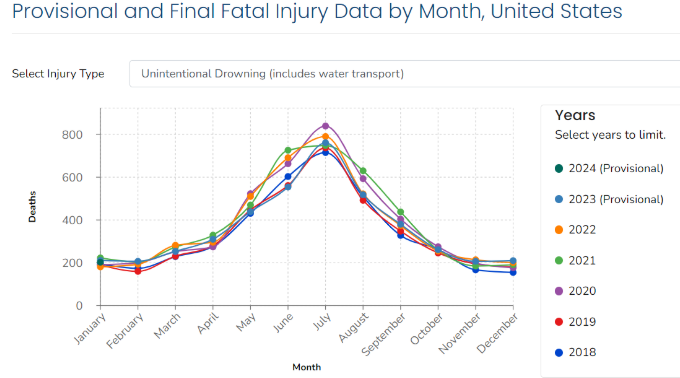
a chart from https://www.cdc.gov/drowning/data-research/index.html the cdc website showing the number of drowning deaths per month between 2018 and 2024

To understand why off-season drowning happens, it helps to look at how our environment and daily routines change after Labor Day. According to mortality tracking from the CDC WISQARS database, over 2,500 unintentional drowning deaths occur outside of the peak summer months each year in the United States. Nearly 19% of all annual drownings happen during September, October, and November alone.

Those numbers might seem surprising if you picture drowning as something that only happens when a child is actively swimming at a crowded beach. Off-season water accidents rarely involve a child intentionally jumping into a pool or river to go for a swim. Instead, they happen when nobody expects anyone to be near the water at all.

1. Extended Warm Seasons and Uncovered Pools

In many parts of the country, summer heat stretches much further into the autumn months than it used to. High temperatures often linger through October and even into late autumn, leading homeowners to leave their backyard pools open and uncovered far longer into the year.

The problem arises because family routines have already shifted. During July, a parent sitting on the patio, is actively watching the pool because the kids are in swimsuits. In October, that same parent might be doing yard work, raking leaves, or hosting a casual gathering. The pool remains uncovered, but active adult supervision has dropped to zero because "nobody is swimming today."

A wandering toddler chasing a ball or running across a slick deck can fall into an open pool, lake, or pond, in a fraction of a second. Without a dedicated watcher or a secured pool fence, any body of water is a constant, unmonitored hazard.

2. Slower Pool Maintenance and Decreased Visibility

As pool usage drops off in the autumn, home pool maintenance often slows down as well. Filters run less frequently, chemical levels drop, and fallen leaves begin to collect at the bottom of the water.

This creates a severe secondary risk: reduced water clarity. If a child slips and falls into a murky, leaf-filled pool, they become invisible from the surface almost instantly. Seconds matter in a water emergency, and poor water clarity drastically cuts down the chance of a quick rescue.

Another important factor to keep in mind, if someone falls into the water during the Fall, far less people are going to be around that body of water as swimmers and professional lifeguards are far less likely to be around during that time. No matter whether you were intending to swim or not, ending up in the water unprepared is a recipe for disaster, especially when no one is around to help you.

3. Slipperiness, Leaves, and Early Darkness

a wooden deck slippery with water all over it after rain presenting a drowning risk if someone slips and falls into water

Autumn brings specific physical hazards around bodies of water:

4. The "New House" Playdate Effect

Back-to-school season brings new friends, new classmates, and invitations to new houses. Parents frequently send their kids on playdates or after-school hangouts without realizing the host family has an unsecured pool, a backyard koi pond, a hot tub, or an un-fenced creek behind the property.

When children visit an unfamiliar home, curiosity is high and spatial boundaries aren't established yet. Combined with the distraction of parents catching up inside or working from home, non-swimming accidents can happen quickly during casual indoor-outdoor play.

The Power of Continuous, Year-Round Skill Building

Preventing off-season accidents requires a two-pronged approach: maintaining physical barriers at home and ensuring your child possesses muscle memory in the water.

According to data published in a CDC Vital Signs report, drowning remains the leading cause of unintentional injury death for children ages 1 through 4 in the United States, and the second leading cause for kids up to age 14. Yet, research shows that participating in formal, structured swim lessons reduces the risk of drowning by up to 88% among young children (source).

The word to focus on is formal. Casual summer splashing builds familiarity, but it does not automatically build life-saving self-rescue skills.

When families pull their kids out of swim lessons in September, a noticeable regression occurs over the next eight to nine months. Muscle memory fades, breath control weakens, and water confidence drops. When summer returns, these children often spend the first two months just trying to regain the comfort level they had the previous August.

By keeping children enrolled in indoor swim lessons through the fall and winter, parents accomplish three vital goals:

  1. They eliminate skill regression. Weekly practice reinforces foundational safety habits like rolling onto the back to float, finding the edge of the pool, treading water, and controlling breathing when unexpectedly submerged.
  2. They build real physical stamina. Stroke mechanics and endurance take time to develop. The quiet indoor months of autumn and winter are when strong, capable, confident swimmers are actually made.
  3. They instill year-round water respect. Children who swim year-round learn that water safety isn't a seasonal novelty, it is a life skill that applies whether they are at a summer beach, a winter hotel pool, or a fall backyard party.

Actionable Off-Season Water Safety Checklist for Families

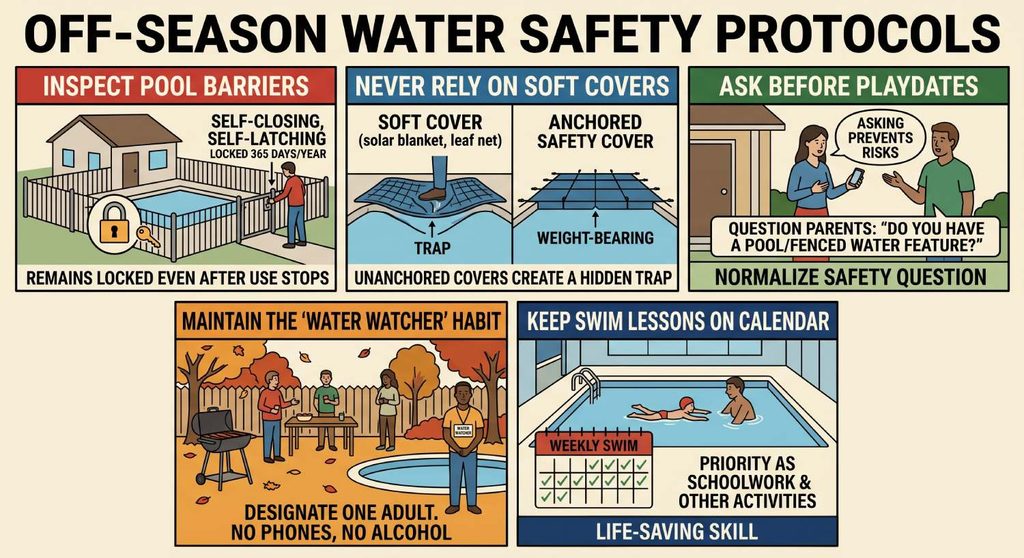
Inspect Your Pool Barriers: If you own a pool, ensure your four-sided isolation fence with a self-closing, self-latching gate remains locked 365 days a year, even after you stop using the pool for the season.

Never Rely on Soft Covers Alone: Solar blankets and thin leaf nets are not safety covers. In fact, an unanchored solar cover creates a hidden trap if a child falls on top of it, wrapping around them in the water. Use a rigid, weight-bearing safety cover anchored to the deck.

Ask the Right Questions Before Playdates: Don't hesitate to ask host parents: "Do you have a pool or water feature in the yard, and is it fenced off?" Making this a standard question normalizes safety for everyone.

Maintain the "Water Watcher" Habit: If you host a fall gathering, barbecue, or tailgate where an open pool or pond is nearby, designate an adult "Water Watcher" whose sole job is to keep eyes on the water without distractions like phones or alcohol.

Keep Swim Lessons on the Calendar: Treat weekly indoor swim lessons with the same priority as schoolwork, soccer, or piano practice. It is one of the very few extracurricular activities that doubles as a permanent, life-saving skill.

To protect your children as the school year gets into full swing, put these basic off-season safety measures into practice today:

  1. Inspect Your Pool Barriers: If you own a pool, ensure your four-sided isolation fence with a self-closing, self-latching gate remains locked 365 days a year, even after you stop using the pool for the season.
  2. Never Rely on Soft Covers Alone: Solar blankets and thin leaf nets are not safety covers. In fact, an unanchored solar cover creates a hidden trap if a child falls on top of it, wrapping around them in the water. Use a rigid, weight-bearing safety cover anchored to the deck.
  3. Ask the Right Questions Before Playdates: Don't hesitate to ask host parents: "Do you have a pool or water feature in the yard, and is it fenced off?" Making this a standard question normalizes safety for everyone.
  4. Maintain the "Water Watcher" Habit: If you host a fall gathering, barbecue, or tailgate where an open pool or pond is nearby, designate an adult "Water Watcher" whose sole job is to keep eyes on the water without distractions like phones or alcohol.
  5. Keep Swim Lessons on the Calendar: Treat weekly indoor swim lessons with the same priority as schoolwork, soccer, or piano practice. It is one of the very few extracurricular activities that doubles as a permanent, life-saving skill.

Water safety is not a seasonal event, and drowning does not take the autumn off. By recognizing the unique hazards of the shoulder months and prioritizing continuous, year-round water education, you can ensure your family stays safe in every season.

Sign Up For Swim Lessons

If you want to learn more about swimming lessons, please visit https://hvswim.com/find-a-location/ to find the swimming school nearest you. We have locations all over the United States that are passionate about water safety.

What Swim Level Is Right for My Child? A Guide for Parents

One of the most common questions parents have when signing their child up for swim lessons is simple: Which swim level should I choose?

Age is an important starting point, but it isn't the only thing that matters. Two children of the same age can have very different experiences in the water. One may already be comfortable putting their face underwater and swimming short distances, while another may be entering a structured swim lesson for the first time.

At Hudson Valley Swim, our swim lesson programs are organized by both age and ability so children can learn alongside swimmers who are working on similar skills. As swimmers become more confident and capable, they can progress through levels that introduce increasingly advanced techniques.

If you're trying to determine where your child belongs, here's a closer look at how our swim levels work.

Start With Your Child's Age

The easiest place to begin is with age.

Hudson Valley Swim divides children's lessons into three primary age groups:

Within those programs, swimmers are further grouped according to their ability.

That second part is important. A 5-year-old who has never taken a swim lesson shouldn't necessarily be in the same class as a 5-year-old who can already swim freestyle and backstroke.

Our different levels allow children to start with skills appropriate for their current ability and continue progressing from there.

Pollywog: Our Youngest Swimmers

Approximate age: 4 months to 2 years

Pollywog is designed to introduce babies and young toddlers to the water in a comfortable, supportive environment.

Parents participate in the water with their child and learn techniques for helping them become comfortable and safe around water. Songs, toys, nursery rhymes, and games help make those early experiences enjoyable while introducing basic aquatic skills.

Pollywog swimmers work on skills such as:

At this age, the goal isn't to have your baby swimming laps. We're beginning the process of helping them develop comfort, familiarity, and foundational skills around the water.

Goldfish: Building Confidence and Independence

Approximate age: 2 to 3 years

Goldfish continues building on many of the skills introduced in Pollywog.

Parents still remain in the water, but children begin working more directly with their Hudson Valley Swim instructor as their confidence and independence grow.

Goldfish swimmers practice skills such as front and back floats, kicking, blowing bubbles, getting their face wet, holding onto the edge, and climbing from the pool without assistance.

They also begin learning another important skill: sitting on the steps and following directions from their instructor.

Some children around 2.5 years old may already be capable of working independently with an instructor, sitting on the steps, and taking direction. Those swimmers may be ready to move into our Starfish level.

Starfish: Beginner Swim Lessons for Ages 3 to 6

Approximate age: 3 to 6 years

Once children enter our Elementary Program, their swimming ability becomes especially important when determining placement.

Starfish is our beginner level for children approximately 3 to 6 years old.

Children should be comfortable working directly with an instructor without a parent in the water and capable of following directions while waiting for their turn.

This is where many of the foundational skills younger swimmers have practiced begin developing into more independent swimming.

Starfish swimmers work on:

If your 3, 4, 5, or 6-year-old is new to swim lessons or hasn't yet developed independent swimming skills, Starfish will often be the appropriate place to begin.

Lionfish: Developing Stronger Swimming Technique

Approximate age: 3 to 6 years

Lionfish is the intermediate level of our Elementary Program.

This class is intended for children who have already developed the foundational abilities taught in Starfish and are ready to work more independently on swimming technique.

The focus begins shifting toward proper body position and coordinated movements of the arms and legs.

Skills include:

At this point, children aren't simply becoming comfortable in the water. They're learning how to become more capable swimmers and beginning to develop recognizable swimming strokes.

Kingfish: Advanced Swimming for Ages 5 to 6

Approximate age: 5 to 6 years

Kingfish is the advanced level of our Elementary Program and builds directly on the skills learned in Lionfish.

Children entering Kingfish should already have a strong foundation. That includes freestyle with good side breathing, backstroke, breaststroke fundamentals, and the ability to tread water for an extended period.

Swimmers then continue refining those abilities while learning skills such as:

For younger children who have progressed through multiple levels, Kingfish provides an opportunity to continue advancing rather than simply repeating beginner skills because of their age.

What If My 7 to 12-Year-Old Is a Beginner?

This is another question parents commonly have.

Being older does not mean your child is expected to already know how to swim.

Our Youth Program has beginner, intermediate, and advanced levels specifically for children approximately 7 to 12 years old.

A 9-year-old who has never learned to swim does not need to be placed in a class with much younger children simply because they're a beginner.

Instead, they can begin in Marlin.

Marlin: Beginner Swim Lessons for Ages 7 to 12

Approximate age: 7 to 12 years

Marlin introduces older beginners to foundational swimming skills in an age-appropriate environment.

Swimmers work on becoming comfortable submerging, rhythmic breathing, basic side breathing, front and back streamlines, floating, treading water, and retrieving objects underwater.

They'll also begin developing several swimming strokes, including:

This allows older beginners to develop the fundamentals while learning alongside children closer to their own age.

Barracuda: Intermediate Swim Lessons for Ages 7 to 12

Approximate age: 7 to 12 years

Once swimmers have developed the basics, Barracuda places greater emphasis on proper technique and stronger swimming.

Students work on continuous side breathing for freestyle, backstroke, properly timed breaststroke, introductory butterfly, and drills designed to improve each stroke.

Additional skills include:

The emphasis gradually moves from simply being able to perform a swimming skill toward performing it with better technique and control.

Shark: Advanced Swim Lessons for Ages 7 to 12

Approximate age: 7 to 12 years

Shark is our advanced Youth level.

At this stage, swimmers continue refining their stroke technique while increasing the distances they're capable of swimming.

Students develop a deeper understanding of all four competitive strokes:

They also begin working on appropriate turns, longer-distance swimming, and the fundamentals of interval training.

For children who love swimming and want to continue challenging themselves, Shark helps bridge the gap between learning how to swim and developing more advanced swimming ability.

Finding the Right Swim Lessons for Your Child

The descriptions above can give you a good idea of where your child may belong, but parents shouldn't feel like they have to evaluate every swimming skill themselves.

Age gives us a starting point. From there, swimming experience, confidence, independence, and existing skills all help determine the appropriate level.

And don't worry if your child doesn't move up after every session.

At Hudson Valley Swim, advancement is based on learning the skills associated with a level rather than simply completing a certain number of lessons. It's common for swimmers to repeat a level as they continue developing and mastering those skills.

What matters most is that your child is in an environment where they can continue learning without being overwhelmed or held back.

The Right Level Is the One That Helps Your Child Keep Progressing

Swimming isn't a race from one level to the next.

A swimmer may pick up kicking quickly but need more time with side breathing. Another child might be comfortable underwater but still be developing the coordination needed to combine their arms and legs. That's normal.

Our instructors can individualize instruction within a class because children at the same level may still be at different stages of mastering its skills.

At Hudson Valley Swim, our goal is to place swimmers in an environment where they can continue building confidence, improving their technique, and developing the skills they need to become stronger swimmers.

If you're ready to get started, explore our swim lesson programs to learn more about the classes available for your child's age and ability. From a baby's first introduction to the water to advanced stroke development, there's a Hudson Valley Swim level designed to help them take their next step.

When Is the Best Age to Start Swim Lessons?

For many parents, one of the biggest questions about swim lessons is simple:

When should my child start?

Some parents wonder if their child is too young. Others worry they may have waited too long.

The truth is, there is no one “perfect” age for every child. Every swimmer develops differently, and comfort around water depends on factors like age, confidence, maturity, and previous water exposure.

However, most swim professionals agree on one thing:

Earlier exposure to water in a safe, structured environment can help children build confidence and stronger safety habits over time.

For many families, swim lessons are not just about learning strokes. They are about helping children become safer, more confident, and more comfortable around water.

Why Starting Swim Lessons Earlier Can Make a Difference

Many parents wait until summer begins, an upcoming vacation approaches, or their child is invited to more pool parties before thinking about swim lessons.

In reality, confidence around water is usually built gradually through repetition and positive experiences.

Starting swim lessons earlier gives children more time to:

Water exposure often begins earlier than parents expect. Children may encounter water during vacations, hotel stays, family gatherings, camps, swim parties, beach trips, boating outings, splash pads, and neighborhood pool visits.

Research published through the National Institutes of Health found that formal swim lessons may reduce the risk of drowning among young children by as much as 88%.

For many families, swim lessons become less about “learning to swim” and more about helping children feel safer and more confident whenever water is involved.

Swim Lessons by Age: What Parents Should Expect

Every child develops differently, but understanding the general age ranges can help parents choose the right starting point.

At Hudson Valley Swim, programs are designed around different developmental stages so swimmers can build confidence in a way that makes sense for their age, comfort level, and ability.

Infant & Toddler Swim Lessons: 4 Months to 2 Years

For babies and toddlers, swim lessons are less about independent swimming and more about safe water introduction, comfort, and early familiarity.

Infant and toddler swim lessons often focus on:

At this stage, the goal is not to rush children into advanced skills. The goal is to help them feel safe, supported, and comfortable in the water.

For many families, starting during infancy or toddlerhood can help reduce fear later and create a healthier relationship with water from the beginning.

Elementary Swim Lessons: Ages 3 to 6

Ages 3 to 6 are often an important window for building foundational swim skills.

At this stage, many children are ready to follow simple instructions, practice with an instructor, and develop stronger independence in the water.

Elementary swim lessons often focus on:

This is often when parents begin to see major confidence breakthroughs.

Small milestones, like putting their face underwater, floating without help, or swimming short distances, can quickly build momentum.

For children in this age range, consistency is especially important. Repeated exposure helps skills feel more natural and helps swimmers become calmer around water over time.

Youth Swim Lessons: Ages 7 to 12

If your child is between 7 and 12 and has not started swim lessons yet, do not worry.

It is never too late to begin.

Older children often build skills quickly because they are more coordinated, more physically capable, and better able to understand instructions. At the same time, some older beginners may carry more fear or hesitation if they have had limited water exposure or a negative past experience.

Youth swim lessons can help older children:

Many parents are surprised by how quickly older children can progress once they begin consistent lessons in a supportive environment.

Signs Your Child May Be Ready for Swim Lessons

While age matters, readiness matters too.

Your child may be ready for swim lessons if they:

That said, nervous or hesitant children can also benefit from swim lessons.

Children do not need to be fearless before starting. In many cases, confidence is built because of lessons, not before them.

A supportive swim environment can help children gradually become more comfortable while learning at a pace that feels safe.

Is It Ever Too Late to Start Swim Lessons?

One of the biggest misconceptions parents have is:

“I should have started earlier.”

The reality is that children can benefit from swim lessons at almost any age.

Whether your child is an infant, toddler, elementary-age beginner, or older youth swimmer, building water confidence and safety skills is always worthwhile.

Starting later does not mean starting behind.

It simply means starting now.

For children who feel nervous around water or need more individualized attention, private swim lessons can sometimes provide extra comfort, flexibility, and support.

What Matters Most Is Consistency

If there is one thing swim instructors consistently see, it is this:

Confidence around water is built over time.

Children often progress through small milestones:

Some children progress quickly. Others need more repetition and encouragement.

Both are completely normal.

The goal is not perfection overnight. The goal is helping children feel safer, more confident, and more prepared around water over time.

So, What Is the Best Age to Start Swim Lessons?

The best age to start swim lessons is usually:

Earlier than most parents think.

What matters most is helping children build confidence, comfort, and stronger water safety habits before they find themselves in situations where those skills matter.

Water should be associated with confidence, fun, and lifelong memories, not fear or uncertainty.

Whether your child is just being introduced to water or ready to develop stronger swim skills, starting swim education is one of the most valuable investments many families can make.

Hudson Valley Swim Tyler Featured on East Texas Living

Recently, Hudson Valley Swim Tyler had the opportunity to appear on East Texas Living to discuss an important topic for local families: keeping children safer around water.

Hudson Valley Swim Tyler Featured on East Texas Living to Share Water Safety Tips

Summer in East Texas means more time around pools, lakes, splash pads, and family vacations. It also means parents are thinking more seriously about water safety.

Recently, Hudson Valley Swim Tyler owner Erin Riley had the opportunity to appear on East Texas Living to discuss an important topic for local families: keeping children safer around water.

As temperatures rise and swim season ramps up across East Texas, water safety becomes more important than ever. During the segment, Hudson Valley Swim Tyler shared practical advice for families looking to build confidence around water and reduce drowning risks before summer is in full swing.

Local Water Safety Tips Featured on East Texas Living

Hudson Valley Swim Tyler recently joined East Texas Living on KETK to talk about pool safety, drowning prevention, and the importance of helping children build confidence around water early.

The conversation focused on simple but important ways families can help reduce risk around pools and open water while making summer safer and more enjoyable for everyone.

Topics included:

Why Water Safety Matters So Much

Children and families often spend time around:

While these experiences create lifelong memories, they also increase opportunities for accidents if children are not prepared around water.

One of the biggest misconceptions about drowning is that it looks dramatic. In reality, drowning is often silent and can happen in as little as 20 seconds. Children rarely splash or yell for help the way movies portray.

According to the CDC, drowning remains one of the leading causes of accidental death for children ages 1 to 4. Many drowning incidents also happen while an adult is nearby or assumes another adult is supervising.

That is why water awareness, supervision, and swim confidence all matter.

Key Water Safety Reminders for Parents

During the East Texas Living segment, several important reminders stood out for families preparing for summer.

Practice Active Supervision

Children should never be left unattended around water, even briefly.

Phones, conversations, and distractions can pull attention away faster than many parents realize. Even children who have experience in the water still require close supervision.

At the same time, many parents feel greater peace of mind when children are more comfortable and confident around water. While supervision should never be replaced, youth swim lessons can help children build stronger swim safety skills and familiarity with aquatic environments.

Do Not Depend Entirely on Floaties

Inflatable arm floaties and pool toys are not substitutes for swim skills or supervision.

While they may help children feel temporarily comfortable, they can sometimes create a false sense of confidence for both children and adults.

Helping children build real swim confidence through structured instruction often provides a stronger long-term foundation.

Build Confidence Before Summer Begins

Many parents wait until summer is already underway to think about swim readiness.

In reality, confidence around water is usually built gradually through repetition and positive experiences.

Small milestones often become major breakthroughs, such as:

Research published through the National Institutes of Health found that formal swim lessons may reduce the risk of drowning among young children by as much as 88%.

For many families, starting youth swim lessons before peak summer season helps children feel more prepared for pools, lake outings, camps, and vacations.

For younger swimmers, infant and toddler swim lessons can help introduce water in a safe and encouraging environment designed to build comfort gradually.

Water Confidence Matters for the Whole Family

Water safety is not just about children.

Many adults never fully learned how to swim or never developed confidence around deeper water. As a result, some parents feel nervous around pools, lakes, or emergency situations involving water.

Building stronger swim skills as an adult can help parents feel more prepared not only for themselves, but for their children and loved ones as well.

For adults looking to feel safer and more confident around water, adult swim lessons can be an incredibly valuable investment.

Helping Families Feel More Confident Around Water

At Hudson Valley Swim, water safety is at the center of everything we do.

Whether your child is just getting comfortable in the water or ready to build stronger swim skills, our goal is to help families feel more confident and prepared around water.

If you are ready to help your child become safer and more confident in the water this summer, explore our swim lesson programs today and take the next step toward stronger water confidence.

Why Hudson Valley Swim is the Best Choice for Your Little Swimmer

When it comes to introducing your child to the water, finding the right swim school is essential. At Hudson Valley Swim, we specialize in swim lessons for all ages and all swimming levels. Our baby swim classes and our toddler swim classes provide a safe, fun, and effective way for young children to develop confidence in the water. Located at indoor heated pools, our small class sizes, and expert trainers offer the best learning environment for your little swimmer.

Water Safety Matters: Start Swim Lessons Early

Did you know that it only takes 20 seconds for a child to drown? Water safety is a crucial skill that all children should learn as early as possible. The American Academy of Pediatrics (AAP) recommends that children start swim lessons by age one to help prevent drowning and build essential water survival skills. At Hudson Valley Swim, we create a fun and supportive environment where even the youngest swimmers can learn to feel comfortable and safe in the water.

The Benefits of Baby & Toddler Swim Classes

Enrolling your child in baby swim classes or toddler swim classes isn’t just about having fun—it’s about building vital water safety skills. Early swim lessons help children develop comfort and independence in the water while improving coordination and cognitive development. Our specialized programs focus on gentle water introduction, breath control, floating, and basic stroke techniques tailored to each child’s age and ability.

Indoor Heated Pool: Swim Year-Round Consistently and in Comfort

At Hudson Valley Swim, we believe that swim lessons should be available in every season without weather and temperature disruptions. Our indoor heated pools provide a comfortable, climate-controlled environment where your child can swim no matter the weather. This consistency ensures that skills develop without seasonal interruptions, leading to faster progress and greater confidence in the water.

Small Class Sizes for Personalized Attention

We understand that every child learns at their own pace. That’s why we keep our small class sizes, allowing for individualized instruction and a more focused learning experience. With fewer students per class, our instructors can provide hands-on guidance, ensuring each swimmer receives the attention they need to succeed.

Expert Trainers Dedicated to Water Safety & Skill Development

Our expert trainers are passionate about teaching children how to swim safely and effectively. With years of experience in swim instruction and water safety, our instructors use proven techniques to help your child build strong swimming skills. Whether it’s a baby’s first water experience or a toddler working on independent floating and kicking, our trainers create a supportive and engaging learning environment.

Visit Us at One of Our Nation-Wide Locations

At Hudson Valley Swim, we are committed to providing the best baby swim classes and toddler swim classes in the area. With our indoor pool, small class sizes, and expert trainers, we ensure a fun, safe, and educational experience for your little swimmer.

Water safety starts now—don’t wait! Come visit us and see why parents trust us for their child’s swimming journey. Contact us today to learn more and enroll in a class!

Choosing the Right Swimming Lessons in Seminole: What to Look For

Swimming is an invaluable skill that offers a multitude of benefits. Whether you're a parent seeking lessons for your child or an adult eager to acquire this essential skill, finding the right swimming lesson program is a pivotal decision. Here are some key factors to consider when selecting swimming lessons to ensure a safe, effective, and enjoyable learning experience.

Choosing the right swimming lessons involves careful consideration of various factors, from the qualifications of instructors to the safety measures in place and the curriculum offered. By prioritizing these elements, you can ensure a rewarding and enriching swimming learning experience that equips you or your loved ones with a vital life skill while fostering confidence and enjoyment in the water.

At Hudson Valley Swim, we maintain small class sizes to ensure the student gets the care and support needed in a fun and safe environment. Our swimming instructors are experienced and are trained to teach all levels, so children don’t have to change instructors as they advance through the levels.