Maybe you first signed up for swim lessons to feel more comfortable on vacation. Perhaps you wanted to enjoy the pool with your family, or finally learn something you had been putting off for years.
Whatever brought you to the water, those first steps are worth celebrating! And once you start feeling more comfortable, there is plenty to look forward to.
At Hudson Valley Swim Port Chester, we want swimming to become an enjoyable part of your life. Our adult swim lessons give you time to move, learn, build confidence, and focus on yourself with an instructor there to guide you.
You don’t need competitive ambitions or a list of strokes you want to master. Wanting to feel healthier, enjoy the water, or have an activity that belongs to you is a good reason to keep coming back.
Here are some of the ways regular swimming lessons can add something valuable to your week.
If you spend much of your day at a desk, behind the wheel, or working through the same daily tasks, time in the pool can be a welcome change!
Swimming brings multiple muscle groups into one activity. Your arms and shoulders help move you through the water, your legs contribute to propulsion, and your core helps maintain your position. Depending on your pace and how long you swim, it can also provide aerobic exercise that challenges your heart and lungs.
In our lessons, you have guidance as you work. You can ask questions, receive feedback, and build toward activities that suit your current ability.
You can start at your own pace, taking breaks whenever you need them and gradually building up your time in the water as your comfort and endurance improve. The goal is to find a routine that feels good, keeps you moving, and makes you look forward to your next swim.
Finding exercise you enjoy can take some trial and error. An injury or joint pain can make it difficult to stay active, especially when running or lifting weights causes discomfort. Swimming offers a low-impact alternative that supports your body in the water while still giving you an opportunity to exercise and build a regular fitness routine.
Water supports part of your body weight, reducing the impact associated with many activities on land. You still work against the resistance of the water, but without the repeated stress on your joints in activities such as running.
The CDC identifies swimming and water exercise as joint-friendly activities. It also notes that water-based exercise can help some people with arthritis exercise with less joint discomfort.
During swim lessons, we can help you find a manageable starting point and work toward your goals gradually. Tell your instructor what feels comfortable and where you are having difficulty so they can guide the session.
It is easy to plan on exercising more and then watch the week fill up around that intention.
A regular swim lesson gives that time a place on your calendar. There is a session to attend, an instructor to meet, and something to work toward when you arrive.
That structure can make getting started feel more manageable. You don’t have to plan a workout or decide what to practice on your own.
Your goal might be to feel less tired in the water, become comfortable visiting the pool independently, or build an exercise routine you enjoy. We can help you work toward those goals one session at a time.
With consistency, your lesson at Hudson Valley Swim Port Chester can become a familiar part of the week: time you have already set aside to do something positive for yourself.
Work messages, errands, family responsibilities, and unfinished tasks can follow you from morning to night. Sometimes it helps to have an activity that asks you to put everything else down for a while.
In the pool, your attention shifts to what you are doing. You listen to your instructor, focus on your movements, and work through the activity in front of you. Your phone stays out of the water.
For some swimmers, that focused time is part of the appeal of coming to lessons.
Swimming can also support emotional well-being. The CDC reports that swimming can improve mood, while regular physical activity more broadly can reduce feelings of anxiety and improve sleep quality.
You may enjoy the exercise, the change of setting, or the satisfaction of making progress. Regular lessons give you a recurring opportunity to step away from your usual demands and spend time doing something engaging.
There is something satisfying about learning as an adult, especially when the goal is entirely your own.
During a swim lesson, you might try an adjustment your instructor suggests and notice that moving through the water feels easier. You might remember something from the previous session and put it into practice with greater confidence.
These moments give you a chance to pay attention, solve a problem, and recognize your progress.
Staying active can benefit more than just your physical health. According to the CDC, regular physical activity also supports brain health, including memory and thinking skills, and can help reduce the risk of cognitive decline. While these benefits apply to physical activity in general, swimming offers one enjoyable way to incorporate movement into your routine.
In our lessons, the immediate opportunity is simple: you have something interesting to learn, support as you practice, and room to keep challenging yourself.
Trying an activity as an adult can feel easier when you have encouragement!
In group lessons, you may meet people who share some of your reasons for being there. One person might be returning to swimming after years away. Another might want a different way to exercise. Someone else may be working toward feeling comfortable in the water for the first time.
You don’t have to share the same starting point to appreciate one another’s progress.
A conversation before class, a familiar face, or a little encouragement during a session can make attending more enjoyable. Over time, that recurring contact can give your lesson a sense of connection as well as purpose.
Our adult swim lessons offer an opportunity to learn with guidance and encouragement. If you prefer individual instruction, private lessons offer time to work closely with your instructor. We want you to find a format that feels comfortable and supports what you hope to accomplish.
Sometimes the most meaningful goal is being able to say yes to an experience you would otherwise avoid.
For Port Chester residents, that might mean enjoying a local pool, looking forward to summer outings along Long Island Sound, or feeling more comfortable during family vacations. Perhaps you would like visiting the pool to become an ordinary option in your week.
Regular lessons give you more opportunities to become familiar with the water in a supervised learning environment.
We can help you work toward that comfort at a manageable pace. You have time to ask questions, revisit activities, and practice with guidance instead of feeling pressured to figure everything out at once.
As your confidence grows, you may find more opportunities to enjoy swimming outside your lessons. Always match those activities to your abilities and the conditions. Experience in a pool does not automatically prepare you for currents, waves, or other open-water challenges.
Much of adult life revolves around doing things for other people. You may spend your days meeting expectations at work, supporting your family, or managing responsibilities that rarely pause.
Swimming gives you something to pursue for yourself!
Progress might mean completing a session with more energy, feeling comfortable in water that once made you nervous, or looking forward to an activity you used to avoid. Those achievements matter because they make a difference to your experience.
At Hudson Valley Swim Port Chester, we want to help you recognize that progress and decide what you would like to work toward next.
Your reasons for swimming can change along the way, too. Lessons that begin as preparation for a vacation might become a favorite form of exercise. A goal to build confidence might grow into a regular opportunity for relaxation or connection.
There is room for swimming to become whatever worthwhile part of your routine you want it to be.
Learning to feel comfortable in the water is an accomplishment. Continuing lessons gives you an opportunity to enjoy what comes next!
At Hudson Valley Swim Port Chester, we’re here to help you build a routine that fits your goals, whether that means staying active, finding confidence, meeting others, or setting aside some time for yourself.
You don’t need to arrive with a big ambition. A little curiosity and a willingness to keep learning are a good place to start.
Explore our adult swim lessons in Port Chester, NY to learn about your options. We’d love to help you make swimming a part of your life that you look forward to.
When summer ends, swim lessons can slip down the family priority list. School schedules fill up, outdoor pools close, and trips to the beach feel far away. But the benefits of learning to swim don’t disappear when the weather turns cold!
Winter swim lessons give children a consistent opportunity to stay active, build confidence, and practice skills that extend beyond the pool. While learning to swim safely remains the primary goal, each lesson also involves listening, coordinating movements, communicating, and working through challenges.
At Hudson Valley Swim Port Chester, children build their swimming skills through consistent instruction, practice, and encouragement. Continuing lessons through winter helps your child maintain what they’ve learned while developing skills they can use throughout the year.
Here are six reasons for Port Chester families to continue swim lessons when summer is over.
During warmer months, physical activity often happens naturally. Children spend time at playgrounds, ride bikes, and play outside after school. As winter arrives in Port Chester, cold weather and earlier sunsets can make those opportunities harder to fit into the day.
Indoor swim lessons provide a scheduled opportunity to move, regardless of the outdoor temperature.
During a lesson, children practice kicking, reaching, floating, and moving through the water. The specific activities depend on their age and ability, but the routine gives them dedicated time to participate in an active learning experience.
For parents, having that activity already on the calendar can help. Instead of finding something new to do each week, swimming becomes a familiar part of the family schedule.
When outdoor activities become less convenient, lessons give children something active and engaging to look forward to.
Swimming asks children to bring several movements together. They may need to coordinate their arms and legs, adjust their body position, and learn when to breathe.
Those movements take practice. A child might understand how a kick should look after watching an instructor but still need time to perform it consistently.
Consistent lessons break these challenges into manageable steps. Depending on their level, children may work on:
These activities give children opportunities to become more aware of how their bodies move. Continuing lessons through winter provides more time to practice those movements and build on what they have already learned.
At Hudson Valley Swim Port Chester, we help children work through these challenges with instruction and encouragement as they develop their swimming abilities.
Swim lessons are an active learning experience! Children listen to their instructors, watch demonstrations, and follow directions as they practice new skills. They also have the opportunity to learn alongside other swimmers, take turns, and put directions into practice.
For a younger swimmer, that might mean hearing “hold the wall and kick” and responding with the correct movement. A more experienced swimmer may work through a sequence involving a push-off, a glide, and a particular stroke.
As children progress, they have opportunities to practice:
These are familiar parts of learning in many settings, including school and other activities. Swim lessons give children another place to practice while pursuing a concrete goal.
Continuing lessons keeps that learning routine going during a season when Port Chester families may spend more time indoors.
Confidence grows with practice and experience! As children learn new swimming skills, they have opportunities to try something unfamiliar, receive encouragement from their instructor, and celebrate their progress. Over time, these small successes can help them feel more confident and more willing to take on new challenges.
For one child, progress might mean becoming comfortable putting their face in the water. For another, it could mean floating with less assistance or swimming farther with a more controlled stroke.
The size of the milestone matters less than the experience of working toward it!
Regular swim lessons give children opportunities to see how practice contributes to progress. They also learn that an unsuccessful attempt does not have to be the end of the activity. With feedback and another try, they can continue working toward the skill.
At Hudson Valley Swim Port Chester, we want children to recognize their progress along the way. Keeping lessons in the winter schedule gives them more opportunities to experience those small successes and develop confidence in their own learning.
Swimming lessons also involve interaction!
Children communicate with their instructors, ask questions, and learn how to express when they need help. In group lessons, they may also practice taking turns, sharing space, and participating alongside other swimmers.
These moments can be especially useful for young children who are still getting comfortable in structured activities.
An instructor may encourage a child to describe what feels difficult, explain a direction in a different way, or recognize an improvement. Other swimmers can provide encouragement and a sense of shared participation!
Every child’s experience is different, but group swim lessons give children the chance to grow comfortable in the learning environment and connect with other swimmers.
During the winter months, lessons also offer Port Chester families a fun opportunity to get out of the house, interact with others, and enjoy an activity beyond the usual home and school routine.
The broader benefits matter, but swimming’s central purpose remains important: helping children develop skills for the water.
Floating, breathing, reaching the wall, and moving through the pool are skills that require practice. Continuing lessons gives children opportunities to revisit those skills while working toward their next goals.
Consistent swim lessons also help keep swimming skills fresh and familiar. Instead of taking a long break and starting back up later, children can continue practicing what they’ve learned and reinforcing existing skills.
For Port Chester families looking forward to summer pool days and beach outings, winter offers time to continue that development before warmer weather returns.
Every child learns at their own pace, but regular participation provides more opportunities to strengthen skills and continue growing as a swimmer.
Swimming lessons are one part of water safety. Children still need appropriate adult supervision around water, regardless of their ability or confidence. Pool experience also does not automatically prepare a child for waves, currents, or other open-water conditions.
Research has explored connections between early swimming participation and children’s development.
A Griffith University project led by Professor Robyn Jorgensen examined young children who participated in swimming. Researchers reported that participating children performed ahead of age-based norms in several areas, including oral expression, mathematical reasoning, and visual-motor skills. You can read more about the findings in Griffith University’s overview of the research.
Those findings suggest a connection between early swimming participation and aspects of early childhood development. They should not be interpreted as a guarantee that swimming will improve grades or cause a child to reach milestones earlier.
For parents, the practical takeaway is that swimming lessons offer a rich learning environment. Children hear instructions, explore movement, communicate, and work through new tasks while developing their swimming abilities.
Winter swim lessons offer more than preparation for next summer. They give children a regular place to move, learn, interact, and experience progress.
The goal does not have to be reaching a particular milestone by a particular date. A consistent schedule allows children to keep practicing at a pace appropriate to their abilities, with instruction that helps them work toward the next step.
At Hudson Valley Swim Port Chester, we’re here to help your child keep building confidence and swimming skills throughout the year. Whether they are becoming comfortable in the water or developing more advanced abilities, the colder months can be a valuable time to continue learning.
Explore swim lessons in Port Chester, NY to find a program for your child and keep their progress moving throughout the winter!
“Does your child know how to swim?”
It sounds like a simple yes-or-no question. For many parents, the answer is yes if their child can jump into a familiar pool, paddle a short distance, or get back to the wall without help.
Those are meaningful accomplishments. However, they do not always provide a complete picture of a child’s ability in the water, and they do not necessarily mean that the child is “water safe.”
Can the child float independently? Can they tread water? Can they control their breathing? What happens if they enter the water unexpectedly or cannot touch the bottom? Can they swim far enough to reach an exit without becoming exhausted? Are they a strong enough swimmer to overcome the weight of clothing and shoes if they fall into the water unexpectedly?
These are especially important questions for families in Port Chester, where community pools, marinas, boating, beaches, and the waters of Long Island Sound create many opportunities to spend time around water.
A child who can move through a backyard pool has developed basic swimming ability. A more capable swimmer can combine breathing, floating, body control, endurance, technique, and good decision-making in a wider range of situations.
Understanding that difference can help parents identify the skills their child already has and the ones they still need to develop. The swim lesson programs at Hudson Valley Swim Port Chester are designed to help swimmers make that progression one skill at a time.
Swimming ability exists on a spectrum.
One child may be comfortable jumping into the shallow end but struggle when they cannot stand. Another may be able to swim underwater but have difficulty floating on their back. A child might cross a small pool using an inefficient paddle but become tired quickly in deeper or unfamiliar water.
Each of these children can swim in some capacity. That does not mean they are water safe.
Rather than only asking whether a child can swim, parents should consider more specific questions such as:
These questions reveal much more about a child’s comfort, control, and overall water-safety competence.
Basic swimming ability usually means that a child can move through the water under familiar and controlled conditions. That is an important stage of learning, but water-safety competence goes further.
Water-safety competence involves using several physical and decision-making skills together. A more water safety-competent swimmer may be able to:
The American Academy of Pediatrics describes water-safety competency as the ability to get out of the water when someone enters unexpectedly. It also recommends looking for programs with experienced, well-trained instructors that teach both swimming and water-safety skills.
No single skill makes a child safe in every aquatic environment. Instead, children become more capable by developing multiple skills and learning how to use them together.
For younger beginners, the elementary swim program in Port Chester develops water comfort, foundational swimming technique, and essential safety skills through progressive levels based on each swimmer’s demonstrated ability.
Parents can use the following questions to take a closer look at their child’s current swimming ability.
Swimming does not always begin with a calm push from the wall. A child could slip from a pool step, fall from a dock, or enter the water more quickly than expected.
A capable swimmer should learn how to:
Practicing controlled entries helps children become more comfortable with the transition from land to water.
Floating gives a swimmer an opportunity to rest, breathe, and regain control.
Some children learn to move forward before they become comfortable lying still in the water. They may be able to paddle briefly but panic when they become tired.
Back floating is especially valuable because it allows the swimmer to keep their face out of the water while using less energy than continuous forward swimming.
A child should gradually learn to:
Floating may look simple, but it requires trust, balance, breath control, and body awareness.
These foundational abilities are introduced early in the infant and toddler swim program at Hudson Valley Swim Port Chester, where young swimmers begin developing water comfort and body awareness with support from a parent or caregiver.
Treading water helps a swimmer remain in one place without holding onto the wall or standing on the bottom.
This skill can be useful when a swimmer needs time to:
The amount of time a child can tread water will depend on their age, experience, technique, and endurance. The goal is not to reach an arbitrary number immediately. The goal is to develop increasingly efficient control so the child does not exhaust themselves unnecessarily.
As children advance through the youth swim program in Port Chester, they continue developing treading ability alongside stronger strokes, improved breathing, and greater endurance.
Breath control is about more than seeing how long a child can remain underwater.
Long breath-holding contests should not be treated as a measure of swimming safety. Instead, swimmers should learn how to inhale at the appropriate time, exhale into the water, and maintain a consistent breathing pattern while moving.
Useful breathing skills include:
A swimmer who cannot coordinate their breathing may become tired or anxious even if their arms and legs are moving effectively.
Children should learn to identify the nearest safe exit and move toward it.
In a backyard pool, the wall may only be a few feet away. In a larger pool, the swimmer may need more endurance and better technique to reach it.
Parents can consider whether their child can:
The ability to reach an exit is more informative than whether a child can perform a short, rehearsed swim directly toward a waiting adult.
Reaching the wall is important, but the swimmer must also know what to do next.
Depending on their age and size, children can practice:
Exit skills should be practiced alongside entries so children understand the complete process of getting into and out of the water safely.
Some children appear confident as long as their feet can reach the pool floor. Their behavior may change quickly in deeper water.
A child who is dependent on standing may:
Lessons in appropriately deep water can help swimmers learn to trust their skills instead of depending on the pool floor.
This does not mean children should be pushed into deep water before they are ready. Experienced instructors introduce greater depth gradually while providing structure, support, and clear expectations.
Swimmers who need more individualized assistance with water anxiety, sensory needs, or a particular skill may benefit from private or special-needs swim lessons in Port Chester. This format allows instruction to be adapted to the swimmer’s comfort level, learning style, abilities, and goals.
Goggles can make lessons more comfortable and help swimmers see underwater. They are a useful piece of swim equipment, but children should gradually become comfortable if their goggles leak or fall off.
Similarly, inflatable arm bands, pool floats, and other toys should not be confused with swimming ability. A child who can move confidently while wearing a flotation device may not respond the same way without it.
Children should learn that:
A child’s skills should not disappear completely when a familiar piece of equipment is removed.
Water safety involves judgment as well as physical ability.
Children should learn to:
Confidence is valuable, but it should grow alongside respect for the water. A swimmer who overestimates their ability may take risks they are not prepared to manage.
A child does not need a competition-ready butterfly stroke to develop meaningful water-safety skills.
Floating, treading water, breath control, body position, forward movement, changing direction, and reaching an exit are more directly connected to practical water competence.
Knowing a safety stroke such as elementary backstroke, which allows a swimmer to rest while continuing to propel themselves, is also important. Learning multiple strokes provides additional benefits.
Freestyle, backstroke, breaststroke, and butterfly teach swimmers different ways to coordinate their bodies and move through the water. Continued stroke development can improve:
Proper technique also helps swimmers conserve energy. A child who relies on an inefficient paddle may be able to cross a small pool, but that same movement may not work over a longer distance.
Stroke development should therefore be viewed as part of becoming a stronger and more adaptable swimmer, even though mastery of every competitive stroke is not the sole definition of water safety.
For swimmers ready to improve all four competitive strokes, starts, turns, and endurance, competition clinics at Hudson Valley Swim Port Chester provide more advanced instruction while reinforcing efficient movement through the water.
Children often perform best in places they know.
They may know where the steps are, which areas are shallow, how far they must swim, and where a parent usually stands. That familiarity can make their swimming ability appear stronger than it would in a different environment.
Conditions can change at:
Open water introduces additional concerns such as currents, waves, limited visibility, uneven surfaces, changing temperatures, and longer distances to an exit.
For Port Chester families, a child who is comfortable in a familiar pool may respond very differently near a marina, at the beach, on a boat, or in the waters of Long Island Sound. Currents, waves, cold water, changing weather, limited visibility, and unfamiliar exit points can create challenges that do not exist in a controlled pool environment.
A child should never be expected to handle every aquatic environment simply because they can swim across a familiar backyard pool.
Endurance is an important part of swimming ability.
A child may understand the mechanics of a stroke but lack the stamina to continue using it over a longer distance. When swimmers become tired, their technique may deteriorate. They may lift their heads, shorten their kicks, stop exhaling correctly, or begin to panic.
Building endurance does not mean pushing children until they are exhausted. It means gradually helping them:
Consistent lessons allow endurance to develop alongside technique rather than expecting a child to rely on effort alone.
At Hudson Valley Swim Port Chester, learning does not stop when a child can move from one side of a small pool to the other.
Our curriculum helps swimmers build skills progressively based on their age, comfort level, and demonstrated ability. Depending on the swimmer’s level, instruction may include:
Lessons remain fun and encouraging, but activities are connected to measurable swimming or water-safety skills.
Small classes also allow instructors to observe how each swimmer performs. A child may be strong in one area while needing additional help with floating, breathing, endurance, or confidence in deeper water.
That individualized feedback helps families understand what the swimmer has mastered and what should come next.
Families can review the complete selection of swim classes available in Port Chester for infants, toddlers, school-age children, teens, adults, competitive swimmers, and individuals who benefit from private or adaptive instruction.
Even strong swimmers require supervision.
The Centers for Disease Control and Prevention explains that formal swimming lessons can reduce drowning risk, but children who have taken lessons still need close and constant supervision around water.
A complete family water-safety plan may include:
No swim school should describe a child as drown-proof. Water conditions, fatigue, injury, clothing, temperature, and unexpected circumstances can affect even an experienced swimmer.
The goal of lessons is to help children become more comfortable, capable, knowledgeable, and prepared while families continue using every available layer of protection.
There is no single test or skill that makes a child completely safe around water.
Instead of relying on a yes-or-no answer, consider the full picture:
If some answers are no, that does not erase the progress the child has already made. It simply identifies what they should learn next.
A child who can paddle across the pool has reached an exciting milestone, but it may be only the beginning of their swimming journey.
Continued lessons can help transform basic swimming ability into stronger technique, greater endurance, better judgment, and increased confidence in a wider range of situations.
Use the Hudson Valley Swim Port Chester level finder to identify an appropriate starting point, then explore our Port Chester swim lesson programs to discover how Hudson Valley Swim Port Chester helps children become safer, stronger, and more capable swimmers.
Choosing a swim school is about more than finding the closest pool or the most convenient class time. Instructor experience, teaching techniques, class size, available programs, and the overall learning environment can all affect how a swimmer feels in the water and how steadily they progress.
Many large swim school chains operate dedicated, highly branded facilities with standardized teaching systems designed primarily for young children. These programs may offer colorful surroundings, consistent lesson formats, and a recognizable experience across multiple locations.
Hudson Valley Swim Port Chester takes a different approach. By offering lessons in an established partner pool and prioritizing experienced instructors, small classes, skill-based activities, and measurable development, Hudson Valley Swim creates an environment where swimmers of different ages and abilities can enjoy their lessons while making meaningful progress.
Both approaches can teach important swimming and water-safety skills, but the experiences they provide may be very different. The right choice depends on the swimmer’s personality, the family’s goals, and the type of environment in which that individual learns most effectively.
One of the most noticeable differences between swim schools is the environment surrounding the lesson.
Many large swim school chains operate dedicated aquatic centers designed specifically for children. These facilities may include colorful decorations, branded characters, family changing areas, and a busy, energetic atmosphere. Several classes may take place in separate sections of the pool at the same time, with instructors teaching, children splashing, and families moving throughout the facility.
Some children respond well to this level of activity. Others may find it difficult to hear instructions, maintain focus, or become comfortable with an unfamiliar skill when there is considerable movement and sensory input around them.
Hudson Valley Swim Port Chester offers lessons in the indoor heated pool at LA Fitness on Boston Post Road. Families do not need an LA Fitness membership to enroll.
Rather than depending on elaborate surroundings to maintain a swimmer’s interest, Hudson Valley Swim creates engagement through instructor interaction, games, structured challenges, encouragement, and the satisfaction that comes from making progress.
A focused environment does not mean lessons are overly serious or rigid. Instructors use toys, songs, games, and positive interaction to keep swimmers involved. The fun takes place within the lesson itself and supports what the swimmer is learning.
This type of environment may be especially helpful for:
The goal is to create an environment where swimmers can enjoy being in the water, connect with their instructor, and concentrate on developing new skills.
A knowledgeable and encouraging instructor can have a major influence on how a swimmer feels about the water.
Many national swim school chains use standardized training systems to create a consistent teaching structure across their locations. This can make it possible to prepare instructors to deliver a defined curriculum using established lesson plans and activities.
Hudson Valley Swim emphasizes experienced instructors who may also have backgrounds in competitive swimming, coaching, education, or aquatic safety. Many hold lifeguard, Water Safety Instructor, First Aid, CPR, AED, and other relevant certifications.
Hudson Valley Swim instructors also complete training in the company’s curriculum. This includes online learning, co-teaching, and supervised instruction until they demonstrate proficiency. Training continues through in-service sessions and additional courses as new educational materials become available.
This combination of prior experience and continued training helps instructors understand that swimmers do not all respond to the same teaching style.
One child may need reassurance before attempting a new skill, while another may need a greater challenge to remain engaged. A swimmer may understand a technique immediately, or they may need to see and practice it in several different ways.
Senior-level coaching helps instructors:
Hudson Valley Swim instructors combine patience, encouragement, and purposeful coaching. Swimmers receive support while also being challenged to develop the skills needed to become safer, stronger, and more independent in the water.
Instructor continuity is another factor Port Chester families may want to consider.
At some swim schools, instructors are trained primarily to teach specific ages or beginner levels. A swimmer may need to change instructors as they progress into more advanced classes.
Hudson Valley Swim’s emphasis on experienced instructors allows many coaches to teach multiple skill levels. When scheduling and class availability permit, a swimmer may be able to continue with an instructor they already know as they advance from beginner skills into intermediate and advanced swimming.
Keeping the same instructor can help preserve:
This continuity may be especially valuable for nervous swimmers, students with special needs, and individuals who need time to become comfortable with a new instructor.
Swimmers are more likely to participate, practice, and return when lessons are positive and enjoyable. Hudson Valley Swim believes that having fun and making progress should work together.
Many swim schools incorporate guided play, games, and positive reinforcement to help children become more comfortable in the water. The important question is how closely those activities connect to the skills being taught.
Hudson Valley Swim Port Chester uses games, dive rings, floating mats, songs, and interactive activities throughout its classes. These activities are selected to reinforce the techniques swimmers are working to master.
Depending on the class level, an activity may help swimmers practice:
For example, retrieving a dive ring can help a swimmer practice submersion and breath control. Moving under a floating mat can build confidence while reinforcing body position and independent movement. Songs and repetition can help infants and toddlers become familiar with new movements in the water.
These activities make lessons engaging, but they are not simply used to fill class time. Each activity supports water safety, swimming development, or confidence.
A small student-to-instructor ratio is important, but families should also consider what swimmers do throughout the entire class.
Hudson Valley Swim’s group lessons are designed to keep students participating throughout the lesson.
In a typical 30-minute class, the instructor works directly with each swimmer while keeping the rest of the group involved in level-appropriate practice. Depending on their abilities, swimmers may work on kicking, floating positions, arm movements, breathing patterns, or other skills from the steps or pool wall while another student receives one-on-one attention.
This structure gives swimmers opportunities to repeat important movements instead of passively waiting for their next turn.
The instructor can also observe how each swimmer responds and adjust the lesson accordingly. When a child is ready for a greater challenge, the instructor can introduce a new variation. When a swimmer needs additional support, the activity can be simplified without separating them from the rest of the class.
The result is a lesson that remains positive and active while still providing individualized attention.
Many swim schools advertise small group classes, but the maximum ratio is only one part of the learning experience.
At Hudson Valley Swim Port Chester, elementary, youth, teen, and adult group classes include no more than four swimmers per instructor. Infant and toddler classes may include up to six parent-and-child pairs because a parent or caregiver remains in the water.
Families should also consider:
Hudson Valley Swim uses small classes to provide individualized feedback within a supportive group environment. Instructors can observe each swimmer closely, correct technique, adjust activities, and help students work toward appropriate goals.
Private, semi-private, and small-group private lessons are also available for swimmers who need more concentrated instruction or want to learn alongside family members or friends.
Many large swim school chains focus primarily on infants and children, often serving swimmers from approximately 4 months through age 12.
Hudson Valley Swim Port Chester provides instruction across a broader age range. Its swim lesson programs include:
This broader program structure allows swimmers to continue developing without outgrowing the swim school.
A toddler can begin building comfort in the water alongside a parent, progress into independent elementary and youth classes, and eventually work on advanced or competitive strokes. Teenagers can improve their technique or prepare for team swimming. Adults can learn foundational skills, refine their strokes, or overcome a longstanding fear of the water.
Families may also be able to enroll swimmers of different ages through the same local program instead of searching for a new swim school as their needs change.
Some swimmers benefit from private instruction, flexible pacing, or lessons adapted to their sensory, behavioral, physical, or communication needs.
Adaptive programs vary considerably among swim schools. Some offer modified group lessons, while others provide one-on-one instruction. Availability may also depend on the individual location and the instructors currently on staff.
Hudson Valley Swim Port Chester offers dedicated one-on-one adaptive and special-needs swim lessons for swimmers age 2 and older.
Depending on the swimmer, an instructor may adjust:
Private adaptive instruction gives swimmers space to build confidence and enjoy the water without being expected to follow the pace of a conventional group class. It also allows the instructor to develop engaging activities around the swimmer’s interests, abilities, and comfort level.
Families should speak with the Port Chester team about current instructor availability and the lesson structure that best fits the swimmer.
Some swimmers want to continue beyond foundational water safety and recreational swimming.
Advanced programs vary among swim schools. Some child-focused chains offer introductory swim-team programs, while other schools provide stroke-development classes or competitive clinics.
Hudson Valley Swim Port Chester offers competitive swimming clinics for swimmers age 5 and older. These 60-minute classes are intended for students who are ready to improve their technique, efficiency, and endurance.
Depending on the swimmer’s level, advanced instruction may cover:
Families with advanced swimmers should ask whether a swim school provides a clear progression beyond basic independent swimming and whether its instructors have the experience to identify and correct technical issues.
Hudson Valley Swim’s competitive clinics allow swimmers to continue developing within the same overall program after mastering foundational skills.
Swim lesson pricing and enrollment structures vary by school.
Many large swim school chains use ongoing monthly enrollment. Some also charge annual registration or membership fees in addition to lesson tuition. Other programs may offer prepaid packages, sibling discounts, or discounted rates for multiple weekly lessons.
Hudson Valley Swim Port Chester operates through structured 7- and 8-week sessions, with classes meeting once each week.
Current group tuition is:
Both options equal $32 per lesson for infant and toddler, elementary, youth, teen, and adult group classes.
Additional current rates include:
Hudson Valley Swim does not charge an annual membership fee, and families do not need an LA Fitness membership to participate.
When comparing swim lesson costs, families should consider more than the advertised price of one class. Other factors include:
A lower advertised lesson price may not represent the lowest total cost once fees and enrollment commitments are included. Families should request a complete explanation of tuition and policies before registering.
Current tuition and enrollment information can be found on the Hudson Valley Swim Port Chester pricing page.
Hudson Valley Swim teaches inside LA Fitness at:
260 Boston Post Road
Port Chester, NY 10573
The facility includes:
The indoor setting allows swimmers to maintain a consistent lesson routine throughout the year, including during colder fall and winter weather.
Consistency matters because swimming skills develop through repetition. Long breaks can cause young swimmers to lose confidence or forget techniques they had only recently begun to master.
Families can review upcoming sessions and enrollment availability on the Port Chester swim lesson schedule.
| Feature | Hudson Valley Swim Port Chester | Typical Large Swim School Chain |
| Facility model | Indoor partner pool at LA Fitness in Port Chester | Dedicated, branded indoor aquatic center |
| Typical atmosphere | Welcoming, engaging, and focused | Highly themed, colorful, and often energetic |
| Instructor approach | Emphasis on experienced instructors, individualized feedback, and measurable progress | Standardized instructor training based on a franchise-wide curriculum |
| Instructor continuity | Experienced instructors may teach swimmers across multiple skill levels | Swimmers may change instructors as their age or level changes |
| Group class size | Up to 4:1 for elementary, youth, teen, and adult classes | Small group ratios are common but vary by company and level |
| Teaching style | Enjoyable activities connected to water safety, confidence, and skill progression | Often incorporates branded games, guided play, and positive reinforcement |
| Age range | Infants beginning at 4 months through teens and adults | Frequently centered on infants and children |
| Adaptive instruction | Dedicated one-on-one special-needs lessons | Adaptive options vary by company and location |
| Competitive development | 60-minute competitive clinics for swimmers age 5 and older | Advanced youth programs vary by company and location |
| Enrollment format | Structured 7- and 8-week sessions | Frequently uses ongoing monthly enrollment |
| Current group price | $32 per lesson | Varies by company, location, and enrollment package |
| Annual membership fee | No annual membership fee | Registration or membership fees may apply |
Program availability, enrollment structures, instructor credentials, class ratios, and facility features vary by swim school. Families should verify current details directly with each program they are considering.
A large swim school chain may appeal to families looking for a dedicated aquatic center, extensive child-focused branding, or a standardized experience across multiple locations.
Hudson Valley Swim Port Chester is designed for families who want lessons to be both enjoyable and productive. Classes incorporate games, encouragement, and positive interaction while keeping activities connected to water safety, confidence, and swimming development.
Hudson Valley Swim may be a strong fit for Port Chester families seeking:
The best swim lessons should not force families to choose between having fun and making progress. Hudson Valley Swim brings both together by creating a positive experience that keeps swimmers engaged while helping them become safer, more capable, and more confident in the water.
The best way to evaluate a swim school is to experience its instructors, environment, and teaching approach firsthand.
Contact Hudson Valley Swim Port Chester to ask about current classes, tuition, upcoming sessions, and introductory lesson opportunities. The local team can also help identify the appropriate class level based on the swimmer’s age, experience, and comfort in the water.
Explore the swim lesson programs and discover how Hudson Valley Swim Port Chester helps swimmers build confidence, improve technique, and develop skills that can last a lifetime.
When Labor Day weekend concludes, most families in Westchester County pack away beach towels, winterize backyard pools, and transition their attention toward the school calendar. The general consensus is that "swimming season" is officially over, and with it, the conversation about water safety naturally fades.
This assumption, while understandable, represents one of the most critical gaps in child safety planning. Water safety is not a summer topic. It is a vital, year-round conversation that should be non-negotiable, particularly given our local environment in Port Chester, NY, which is defined by a dense mix of residential pools, inland waterways, and continuous access to Long Island Sound and the Byram River.
The peak drowning months of June, July, and August may have passed, but the actual risk does not disappear when public pools close and lifeguards go off duty. Changing seasonal conditions create a new landscape of risk that many parents completely miss.
To effectively protect your family, you must understand the environment in Westchester County during the off-season. According to mortality tracking from the CDC WISQARS database, over 2,500 unintentional drownings occur nationally outside of the peak summer months every year. Many of these incidents do not involve swimming at all. They are non-swimming, unmonitored falls into water that nobody expected anyone to be near.
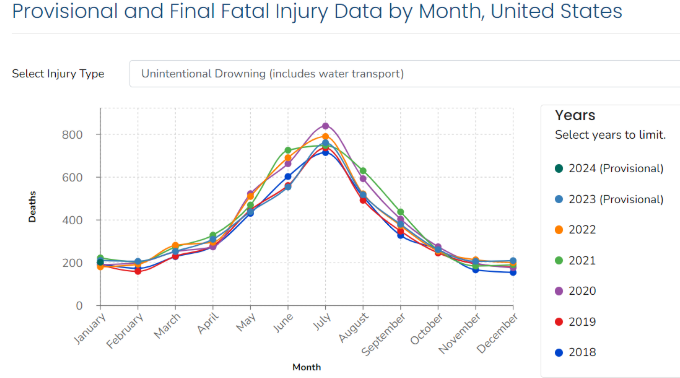
The off-season shifts drowning from an active activity risk (swimming) to a passive environmental risk (unmonitored access). During fall and winter gatherings, our guard is naturally down. When hosting a non-swimming gathering, whether it is an autumn barbecue or a simple playdate, supervision around the water, even a covered or closed pool, often drops to zero.
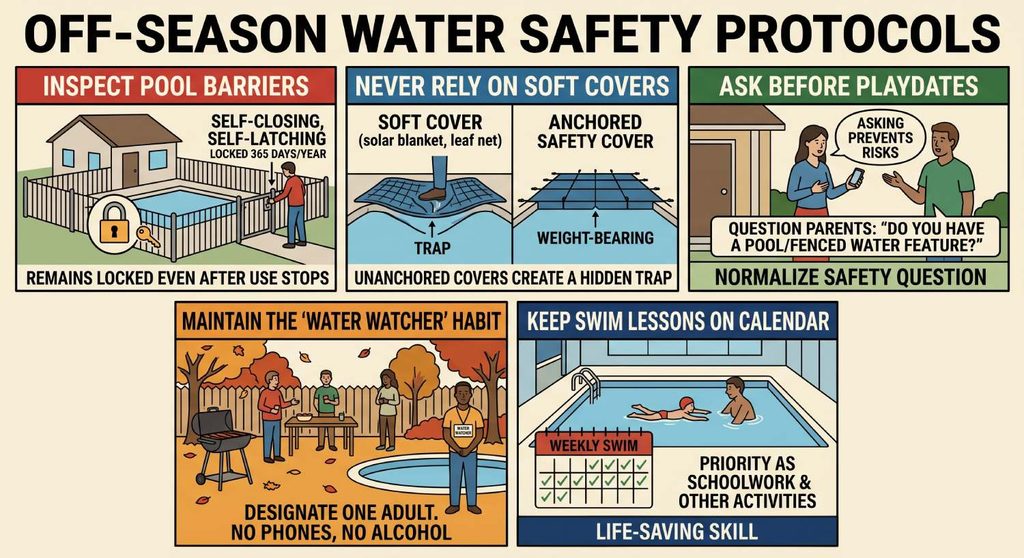
A toddler chasing a leaf, a young child exploring, or a guest navigating a slick deck can fall into an open or poorly secured pool in a heartbeat. Without a dedicated "Water Watcher" (an adult solely focused on the water, without distractions like phones or conversation), a quiet non-swimming fall day can turn catastrophic.
As pool use drops, homeowners frequently slow down on filtering, cleaning, and chemical maintenance. Leaves collect quickly. Murky water, or water with heavy debris, significantly decreases visibility. If a child slips and falls into a murky off-season pool, they cannot be seen, cutting rescue time, seconds that matter most in a water emergency. A pool must remain clear and filtered all winter long as long as it is uncovered.
Autumn and winter bring specific physical hazards to Westchester water features and backyard environments:

In Port Chester, water risks are unique because our geography is not limited to backyard pools. Access to the Byram River, local ponds, creeks, and Long Island Sound coastal margins are often unfenced and completely unmonitored during the non-summer months. Neighborhood play that extends outdoors during the school year frequently brings children dangerously close to these hidden hazards without adult supervision or active lifeguarding.
The most important takeaway for off-season safety is this: You can never "drown-proof" a child, but you can build consistent, life-saving instincts.
Data published in a CDC Vital Signs report confirms that drowning remains the leading cause of accidental injury death for children ages 1 to 4 nationwide. Research demonstrates that formal, structured swim instruction reduces drowning risk among young children by up to 88%.
The danger of pulling kids out of lessons in September is skill regression. Muscle memory, breath control, and water confidence fade during the off-season. When summer returns, those children are not picking up where they left off; they are often spending the first two months relearning skills they had last August.
By maintaining weekly indoor swim lessons through the fall and winter, you accomplish critical goals that casual summer splashing cannot:
As the school year takes priority, we urge all families in the Port Chester area to put these basic safety measures into place today:
Water safety is not a summer event, and drowning does not take the off-season off. By recognizing the changing hazards of our Port Chester environment and prioritizing continuous, formal water education, you provide your family with the layered protection needed to stay safe in every season.
Our dedicated instructors teach year-round indoor swim lessons in a warm, comfortable environment located inside LA Fitness.
Ready to get started? Explore our schedules and find the lesson plans that fit your routine on our Pricing & Schedule page, or give our Port Chester team a call right now at (914) 521-5110.
Location:
Hudson Valley Swim® - Port Chester
LA Fitness
260 Boston Post Rd
Port Chester, NY 10573
One of the most common questions parents have when signing their child up for swim lessons is simple: Which swim level should I choose?
Age is an important starting point, but it isn't the only thing that matters. Two children of the same age can have very different experiences in the water. One may already be comfortable putting their face underwater and swimming short distances, while another may be entering a structured swim lesson for the first time.
At Hudson Valley Swim Port Chester, our swim lesson programs are organized by both age and ability so children can learn alongside swimmers who are working on similar skills. As swimmers become more confident and capable, they can progress through levels that introduce increasingly advanced techniques.
If you're looking for swim lessons in Port Chester, NY and trying to determine where your child belongs, here's a closer look at how our swim levels work.
The easiest place to begin is with age.
Hudson Valley Swim Port Chester divides children's lessons into three primary age groups:
Within our children's programs, swimmers are further grouped according to their ability.
That second part is important. A 5-year-old who has never taken a swim lesson shouldn't necessarily be in the same class as a 5-year-old who can already swim freestyle and backstroke.
Our different levels allow children to start with skills appropriate for their current ability and continue progressing from there.
Approximate age: 4 months to 2 years
Pollywog is designed to introduce babies and young toddlers to the water in a comfortable, supportive environment.
Parents participate in the water with their child and learn techniques for helping them become comfortable and safe around water. Songs, toys, nursery rhymes, and games help make those early experiences enjoyable while introducing basic aquatic skills.
Pollywog swimmers work on skills such as:
At this age, the goal isn't to have your baby swimming laps. We're beginning the process of helping them develop comfort, familiarity, and foundational skills around the water.
Approximate age: 2 to 3 years
Goldfish continues building on many of the skills introduced in Pollywog.
Parents still remain in the water, but children begin working more directly with their Hudson Valley Swim instructor as their confidence and independence grow.
Goldfish swimmers practice skills such as front and back floats, kicking, blowing bubbles, getting their face wet, holding onto the edge, and climbing from the pool without assistance.
They also begin learning another important skill: sitting on the steps and following directions from their instructor.
Some children around 2.5 years old may already be capable of working independently with an instructor, sitting on the steps, and taking direction. Those swimmers may be ready to move into our Starfish level.
Once children enter our Elementary Program, their swimming ability becomes especially important when determining placement.
Hudson Valley Swim Port Chester offers three levels within this age range: Starfish, Lionfish, and Kingfish. Each level builds on the abilities developed before it.
Approximate age: 3 to 6 years
Starfish is our beginner level for children approximately 3 to 6 years old.
Children should be comfortable working directly with an instructor without a parent in the water and capable of following directions while waiting for their turn.
This is where many of the foundational skills younger swimmers have practiced begin developing into more independent swimming.
Starfish swimmers work on:
If your 3, 4, 5, or 6-year-old is new to swim lessons or hasn't yet developed independent swimming skills, Starfish will often be the appropriate place to begin.
Approximate age: 3 to 6 years
Lionfish is the intermediate level of our Elementary Program.
This class is intended for children who have already developed the foundational abilities taught in Starfish and are ready to work more independently on swimming technique.
The focus begins shifting toward proper body position and coordinated movements of the arms and legs.
Skills include:
At this point, children aren't simply becoming comfortable in the water. They're learning how to become more capable swimmers and beginning to develop recognizable swimming strokes.
Approximate age: 5 to 6 years
Kingfish is the advanced level of our Elementary Program and builds directly on the skills learned in Lionfish.
Children entering Kingfish should already have a strong foundation, including freestyle with good side breathing, backstroke, breaststroke fundamentals, and the ability to tread water for 90 seconds.
Swimmers then continue refining those abilities while learning skills such as:
For younger children who have progressed through multiple levels, Kingfish provides an opportunity to continue advancing rather than simply repeating beginner skills because of their age.
This is another question Port Chester parents may have when looking for the right swim lessons.
Being older does not mean your child is expected to already know how to swim.
Our Youth Program has beginner, intermediate, and advanced levels specifically for children approximately 7 to 12 years old.
A 9-year-old who has never learned to swim does not need to be placed in a class with much younger children simply because they're a beginner.
Instead, they can begin in Marlin.
Approximate age: 7 to 12 years
Marlin introduces older beginners to foundational swimming skills in an age-appropriate environment.
Swimmers work on becoming comfortable submerging, rhythmic breathing, basic side breathing, front and back streamlines, floating, treading water, and retrieving objects underwater.
They'll also begin developing several swimming strokes, including:
This allows older beginners to develop the fundamentals while learning alongside children closer to their own age.
Approximate age: 7 to 12 years
Once swimmers have developed the basics, Barracuda places greater emphasis on proper technique and stronger swimming.
Students work on continuous side breathing for freestyle, backstroke, properly timed breaststroke, introductory butterfly, and drills designed to improve each stroke.
Additional skills include:
The emphasis gradually moves from simply being able to perform a swimming skill toward performing it with better technique and control.
Approximate age: 7 to 12 years
Shark is our advanced Youth level.
At this stage, swimmers continue refining their stroke technique while increasing the distances they're capable of swimming.
Students develop a deeper understanding of all four competitive strokes:
They also begin working on appropriate turns, longer-distance swimming, and the fundamentals of interval training.
For children who love swimming and want to continue challenging themselves, Shark helps bridge the gap between learning how to swim and developing more advanced swimming ability.
Choosing the right starting level is only part of the process. Parents also naturally want to know when their swimmer is ready for the next one.
At Hudson Valley Swim Port Chester, moving up isn't simply based on completing one session.
Each level includes a series of skills that swimmers need time to learn and master. It's common for a child to repeat a level as they continue developing those abilities. Every swimmer progresses differently, so some children may be ready sooner while others benefit from additional practice.
Your child's instructor can help determine when they're ready to take the next step.
That takes some of the pressure off parents. You don't need to stand on the pool deck with a checklist trying to decide whether your child's backstroke is good enough for the next class.
The goal isn't to move through the levels as quickly as possible. It's to make sure swimmers have the foundation they need before advancing to more challenging skills.
Age gives us a starting point, but swimming experience, confidence, independence, and existing skills all help determine the appropriate level.
And don't worry if your child isn't at exactly the same point as every other swimmer in the class.
It's normal for some students to be relatively new to a level while others are continuing to work toward mastering its remaining skills. Our instructors can work with swimmers at different stages while keeping the class focused on the abilities associated with that level.
What matters most is that your child is in an environment where they can continue learning without being overwhelmed or held back.
For Port Chester families, developing these skills can also help children feel more comfortable when summer returns and opportunities for pools, beach trips, vacations, and other activities around the water become more frequent.
Swimming isn't a race from one level to the next.
A swimmer may pick up kicking quickly but need more time with side breathing. Another child might be comfortable underwater but still be developing the coordination needed to combine their arms and legs. That's normal.
At Hudson Valley Swim Port Chester, our goal is to place swimmers in an environment where they can continue building confidence, improving their technique, and developing the skills they need to become stronger swimmers.
If you're ready to get started, explore our swim lesson programs and discover how Hudson Valley Swim Port Chester can help you find the right class for your child's age and ability. From a baby's first introduction to the water to advanced stroke development, there's a level designed to help your swimmer take their next step.
As summer winds down and the school year begins, many Port Chester families start changing their routines. Vacations come to an end, outdoor pools begin closing, and attention shifts toward school, homework, and after-school activities.
For some families, swim lessons are one of the first activities to come off the calendar.
It's easy to understand why. Swimming is often associated with summer days at the pool, trips to the beach, and time spent around Long Island Sound. But while summer may be when children have the most opportunities to use their swimming skills, it doesn't have to be the only time they develop them.
At Hudson Valley Swim Port Chester, we encourage families to think of swimming as a year-round skill. Continuing lessons through the fall and winter can help children maintain the progress they've already made, continue building confidence, stay active, and enter next summer as stronger swimmers.
Here are seven reasons to keep swimming after summer ends.
Learning to swim is similar to learning any other physical skill. Progress comes through repetition.
During regular lessons, children have opportunities to practice floating, kicking, breathing, stroke mechanics, treading water, and other skills appropriate for their current level. Over time, movements that once required a lot of concentration begin to feel more natural.
Taking several months away from the pool can interrupt that momentum.
That doesn't mean a child will suddenly forget how to swim. However, after an extended break, some swimmers may need time to rebuild their comfort, endurance, coordination, or technique before moving forward again.
Continuing swim lessons throughout the fall gives children an opportunity to build on what they've already accomplished rather than repeatedly stopping and restarting their progress.
Summer might be swimming season, but fall and winter can be learning season.
Think about where you would like your child to be by next summer.
Maybe they're currently learning to float independently. Perhaps they're beginning to combine their arms and legs, working on side breathing, or trying to swim longer distances without assistance.
Several months of continued lessons can provide a lot of opportunities for growth.
At Hudson Valley Swim Port Chester, our curriculum is designed so swimmers build on previously learned skills as they progress. A child might begin with blowing bubbles, floating, and kicking before eventually developing freestyle, backstroke, breaststroke, butterfly, treading water, diving, and greater swimming endurance.
When lessons continue throughout the year, there is time to make that progression gradually.
Instead of returning to the pool next spring and spending the first few lessons getting comfortable again, your child can arrive at summer ready to use the skills they've been developing all year.
Once school begins, families often start looking for activities that give children something productive to do outside the classroom.
Swim lessons can fit naturally into an after-school routine.
Children spend much of their school day sitting, concentrating, and learning. Getting into the pool gives them an opportunity to move their bodies, work toward new goals, and focus on something completely different from their schoolwork.
Regular swim lessons can provide:
Children don't have to be competitive swimmers for swimming to become a meaningful part of their weekly routine. For Port Chester families, lessons can provide a healthy after-school activity that combines exercise with practical skill development.
As temperatures begin to fall in Westchester County, many of the outdoor activities children enjoy during the summer become less practical.
Swimming doesn't have to be one of them.
Indoor swim lessons give children a way to remain physically active even when colder temperatures and shorter days mean more time spent indoors.
Rather than waiting for warm weather to return, children can continue swimming throughout the fall and winter while developing their technique, endurance, and confidence.
A regular swim lesson also provides something active to look forward to during the colder months and helps keep physical activity part of the family's weekly routine.
Hudson Valley Swim Port Chester's lesson programs are designed around progression.
Our younger swimmers may begin by learning skills such as blowing bubbles, getting their faces wet, floating, kicking, holding onto the wall, and safely climbing out of the pool.
As they progress, those foundational skills lead into more advanced abilities such as freestyle, side breathing, backstroke, breaststroke, butterfly, treading water, diving, and swimming longer distances.
Each stage builds on skills developed earlier.
That's why consistency can be so valuable. Regular lessons give swimmers repeated opportunities to practice what they're learning while gradually adding new challenges as they're ready.
Progress isn't always dramatic from one lesson to the next. Sometimes the biggest improvements happen after weeks of repetition when something that once felt difficult suddenly clicks.
Keeping that routine going throughout the fall and winter gives those breakthroughs more opportunities to happen.
Outdoor pools may close and trips to the beach may become less frequent, but opportunities to be around water don't disappear once summer ends.
Port Chester families may travel during school breaks, stay at hotels, take cruises, visit indoor pools, or vacation somewhere warmer during the winter. Before long, spring and another summer around pools, beaches, and Long Island Sound will arrive as well.
That's why water safety shouldn't be treated as something children only practice during the summer.
Skills like floating, treading water, safely returning to the wall, and understanding personal swimming limits remain valuable regardless of the season.
Swim lessons give children regular opportunities to strengthen those skills while becoming more confident and capable around water.
Not every child feels immediately comfortable in the water.
For hesitant swimmers, summer can sometimes create additional pressure. There may be an upcoming vacation, pool party, summer camp, or family trip where everyone wants them to swim.
Fall and winter offer something valuable: time.
Instead of feeling like they need to become comfortable before next weekend's pool party, children can work at their own pace.
Over several months, a hesitant swimmer may gradually become comfortable putting their face in the water, blowing bubbles, floating, kicking, submerging, and eventually swimming independently.
Those small victories add up.
By the time summer returns, a child who once avoided the water may approach the pool or beach with an entirely different level of confidence.
Swimming may be one of summer's favorite activities, but learning to swim doesn't need to be seasonal.
For Port Chester families, fall and winter provide months of valuable time to maintain the progress children have already made, develop new skills, stay active, and build confidence before warm weather returns.
If your child made progress this summer, continuing lessons can help keep that momentum going. If they're just getting started, enrolling during the fall gives them months to develop their swimming ability before next summer arrives.
At Hudson Valley Swim Port Chester, our swim lesson programs are designed to help swimmers progress at their own pace while developing skills they can use for a lifetime.
Don't wait until the first pool or beach day of next summer to start thinking about swimming again. Explore our swim lesson programs and discover how Hudson Valley Swim Port Chester can help your child keep learning, growing, and building confidence throughout the fall, winter, and beyond.
When people think about learning to swim, they often picture freestyle, backstroke, or diving into the pool.
But one of the most important water skills isn't a swim stroke at all.
It's learning how to float.
Living in Port Chester means having easy access to pools, nearby beaches, and countless opportunities to enjoy the water throughout the year. At Hudson Valley Swim, floating is one of the first skills we introduce in our swim lesson programs because it helps swimmers build confidence, stay calm, and develop the foundation for everything that comes next. Whether someone is a young child taking their first lesson or an adult learning to swim later in life, knowing how to float is one of the most valuable skills they can develop.
While floating alone is not a substitute for knowing how to swim, it is an important survival skill that can make a meaningful difference if someone unexpectedly finds themselves in deep water.
Why Floating Is One of the First Skills Taught
Learning to float isn't simply another milestone in swim lessons. It's one of the building blocks that supports every other swimming skill.
Before swimmers begin learning strokes or refining technique, they first need to become comfortable allowing the water to support them. That's why floating is introduced early in our swim lesson programs.
As swimmers learn to float, they begin developing the ability to:
Once swimmers feel comfortable floating, they're often more prepared to tackle the next stages of learning with confidence.
Panic Is Often More Dangerous Than the Water
Unexpectedly finding yourself in deep water can feel overwhelming.
Whether it's a child who wanders into deeper water than expected or an adult who suddenly loses confidence, panic can quickly make a situation more difficult.
When people panic, they often:
One of the reasons we place such an early emphasis on floating is because it helps swimmers learn to slow down, relax, and trust the water instead of fighting against it.
Remaining calm creates opportunities to think clearly and make safer decisions.
Floating Gives Swimmers Time
One of the greatest benefits of learning to float is that it buys time.
Time to catch your breath.
Time to stay calm.
Time to regain confidence.
Time to signal for help if needed.
Even experienced swimmers can become tired after extended periods in the water. Floating provides an opportunity to recover without constantly using energy to stay above the surface.
Instead of exhausting yourself by struggling to tread water continuously, floating allows your body to rest while keeping your airway above the water whenever possible.
Floating Builds Confidence
One of the biggest transformations we see during swim lessons has nothing to do with learning strokes.
It happens when swimmers realize they can trust the water.
Many beginners arrive believing that if they can't swim yet, they have no control once they're in the pool. Learning to float often changes that perspective completely.
As confidence grows, swimmers become more willing to practice new skills like:
Confidence isn't built in a single lesson. It grows through positive experiences, and learning to float is often one of the first major milestones.
Floating Is an Important Skill for Every Age
Floating isn't just for young children.
It's a valuable skill for:
Our swim lesson programs are designed to meet swimmers where they are, helping each individual build confidence and develop essential water safety skills at their own pace.
Floating Is Only One Part of Water Safety
Although floating is incredibly important, it's only one piece of becoming a safe and confident swimmer.
At Hudson Valley Swim, we believe strong water safety also includes:
Developing these habits alongside swimming skills helps create confident swimmers who make smart decisions around the water.
How We Teach Floating
Learning to float is a gradual process.
Rather than expecting swimmers to master it immediately, our instructors introduce floating step by step while encouraging comfort, confidence, and proper body position.
Lessons often begin with simple water familiarization before progressing to supported floating exercises, breathing techniques, and eventually independent floating as swimmers become more comfortable.
Every swimmer learns differently, and that's perfectly okay. Some gain confidence quickly, while others need more time. Our instructors focus on creating a supportive environment where every swimmer can progress at a pace that's right for them.
A Simple Skill That Can Make a Lifelong Difference
Floating may seem like a simple skill, but it plays an important role in both swimming development and water safety.
It helps conserve energy, encourages calm thinking, builds confidence, and creates the foundation for learning more advanced swimming techniques. While no single skill can eliminate every risk around water, learning to float gives swimmers an important tool that can help them stay safer and feel more confident whenever they're in the water.
In a community like Port Chester, where swimming, boating, and beach days are part of everyday life, developing strong floating skills can help swimmers feel more prepared and confident whenever they head to the water.
If you're ready to build confidence in the water, explore our swim lesson programs and discover how Hudson Valley Swim Port Chester helps swimmers of all ages develop lifelong swimming ability and essential water safety skills.
Enrolling your child in swim lessons is an exciting step, but it's also natural to have questions before that first class. Will they be comfortable in the water? What will they actually do? Will they be expected to swim right away?
At Hudson Valley Swim, we understand that every child starts their swimming journey at a different place. Some children can't wait to jump into the pool, while others need a little extra time to build confidence. That's exactly why our lessons are designed to meet swimmers where they are and help them progress one step at a time.
Your child's first lesson isn't about swimming across the pool. It's about creating a positive experience, building trust with their instructor, and introducing the foundational skills they'll continue developing throughout their swim journey.
We'll Start by Placing Your Child in the Right Class
Every swimmer is different, which is why we offer age and skill-appropriate programs instead of a one-size-fits-all approach.
Our youngest swimmers begin in Pollywog, where parents are in the water alongside their child. As children gain confidence, they progress through programs like Goldfish, Starfish, Lionfish, and beyond, with each level introducing new skills while reinforcing those they've already learned.
Older children and teens are placed into beginner, intermediate, or advanced classes based on their current swimming ability, ensuring they're challenged without feeling overwhelmed.
Starting in the right class allows every swimmer to learn at a comfortable pace while building confidence from day one.
Meet Your Hudson Valley Swim Instructor
One of the first things your child will do is meet their instructor.
Our instructors know that teaching swimming starts with building trust. They'll introduce themselves, welcome your child into the class, and take time to understand their comfort level before beginning any instruction.
Rather than expecting every swimmer to learn the same way, our instructors adapt their approach to each child. Some children are ready to jump right in, while others simply need encouragement and a few positive experiences before they begin trying new skills.
Creating a supportive environment helps children feel safe, confident, and excited to return for their next lesson.
Building Confidence Comes Before Swimming Skills
During the first lesson, the focus is on helping children become comfortable in the water.
For many younger swimmers, that means participating in fun activities that naturally introduce foundational swimming skills. Depending on your child's age and class level, they may practice:
These early activities may seem simple, but they're the building blocks for everything that comes later. Children who feel comfortable in the water are better prepared to learn proper swimming technique as they continue progressing through our program.
Parents Play an Important Role
Many parents wonder if they'll be in the water during their child's first lesson.
For our youngest swimmers in the Pollywog program, parents participate in every lesson. Together, you'll learn techniques that help your child feel safe and comfortable while enjoying songs, toys, and games that make learning fun.
In our Goldfish program, parents remain in the water while children begin working more directly with their instructor and gain confidence becoming more independent.
As swimmers move into our elementary programs, including Starfish and Lionfish, they begin working independently with their instructor while parents cheer them on from the pool deck.
This gradual progression helps children become more confident while ensuring they always receive the support they need.
Every Lesson Builds on the One Before It
Your child's first lesson is just the beginning.
As swimmers become more comfortable, they'll continue developing new skills at each level of our program. What starts with blowing bubbles and floating eventually grows into freestyle, backstroke, breaststroke, butterfly, side breathing, treading water, diving, endurance training, and refined stroke technique.
Because every class builds on previously learned skills, children develop confidence while steadily becoming stronger, safer swimmers.
It's Okay If Your Child Is Nervous
Not every first lesson looks the same.
Some children smile from the moment they enter the pool. Others may cling to a parent, hesitate before getting in the water, or become emotional during those first few minutes.
All of these reactions are completely normal.
Our instructors work patiently with every swimmer, celebrating small victories along the way. For one child, success might be putting their face in the water for the first time. For another, it may be floating independently or kicking across a short distance.
Learning to swim is a process, and confidence often grows a little more with each lesson.
How Parents Can Help After Class
The encouragement children receive after class is just as important as what happens during the lesson.
Celebrate their effort rather than focusing only on new skills. Ask them what they enjoyed most, praise their willingness to try something new, and remind them that every lesson helps them become more comfortable in the water.
Avoid comparing your child's progress to others. Every swimmer develops at their own pace, and consistent attendance is one of the biggest factors in long-term success.
Every Great Swimmer Starts Somewhere
Every confident swimmer began with a first lesson.
At Hudson Valley Swim, our goal is to help every child build confidence, develop strong swimming skills, and become safer in and around the water. Whether your child is just beginning in our Pollywog program or is ready for one of our more advanced classes, they'll be guided by experienced instructors who understand how to make learning both effective and enjoyable.
If you're ready to get started, explore our swim lessons to find the program that's the right fit for your family. We look forward to welcoming you to Hudson Valley Swim and helping your child begin a lifelong journey of confidence in the water.
Starting swim lessons is an exciting milestone, whether you're enrolling a young child or learning to swim yourself.
It's normal to have a few questions before your first visit. What should you bring? What should you wear? Is there anything you should do before arriving?
The good news is that preparing for your first swim lesson is simple.
At Hudson Valley Swim, we want every swimmer to feel comfortable and confident from the moment they walk through our doors. Bringing a few essential items, and knowing what to expect, can help make your first lesson a smooth and enjoyable experience.
For families in Port Chester, where pools, beaches, and year-round warm weather make swimming a regular part of life, arriving prepared helps swimmers start building confidence from day one.
Arrive Ready to Swim
One of the easiest ways to prepare is by arriving dressed in your swim attire.
Our facilities include changing pods on the pool deck if you need them after your lesson, but we recommend arriving ready to swim so you can check in, meet your instructor, and get into the water without feeling rushed.
We also recommend arriving a few minutes early for your first lesson. Giving yourself a little extra time helps everyone settle in before class begins and allows you to start your lesson feeling relaxed.
Wear a Bright Swimsuit
Your swimsuit does more than provide comfort. It also helps improve visibility in the water.
We recommend choosing bright, vibrant colors whenever possible. Bright swimsuits are easier for instructors to see during lessons and can make swimmers more visible in the water.
Whenever possible, avoid swimsuits that are:
Choosing a brightly colored swimsuit is a simple way to improve visibility while creating a better learning environment.
Bring a Pair of Goggles
If there's one item we recommend bringing to every lesson, it's a comfortable pair of goggles.
Goggles help remove one of the biggest barriers many beginners face, putting their face in the water.
Instead of worrying about water getting into their eyes, swimmers can focus on learning new skills and listening to their instructor.
Goggles also help:
It's common for new swimmers to pop up and immediately rub their eyes or look for a towel. Goggles help eliminate those distractions so swimmers can stay engaged and continue building confidence throughout the lesson.
Long Hair? Bring a Swim Cap or Tie It Back
Long hair can quickly become a distraction during swim lessons.
Hair that falls into a swimmer's face often needs to be pushed aside, making it harder to focus on learning and following instructor directions.
For swimmers with hair that reaches their shoulders or longer, we recommend either:
Keeping hair out of the face allows swimmers to concentrate on learning while also helping keep the pool cleaner.
Don't Forget a Towel
It may seem simple, but it's easy to forget a towel when you're preparing for your first lesson.
Having one ready on the pool deck allows swimmers to dry off comfortably after class before heading home.
Swim Diapers for Infants and Toddlers
For swimmers under the age of three, we require they wear both:
Using both provides an extra layer of protection and helps reduce the chance of accidents that can result in temporary pool closures.
It's a simple step that helps keep lessons running smoothly for every family participating in the program.
A Few Optional Items
Although not required, a few extra items can make your visit even more convenient.
Many swimmers also choose to bring:
These items aren't required, but they can make transitioning to and from your lesson a little easier.
What You Don't Need to Bring
First-time swimmers sometimes assume they should bring their own pool toys or training equipment.
Our instructors provide the equipment needed during lessons, allowing swimmers to focus on learning proper techniques instead of bringing extra gear from home.
Leave items like floaties, kickboards, pool noodles, and toys at home unless your instructor specifically recommends otherwise.
You're Ready for Your First Lesson
Preparing for your first swim lesson doesn't have to be complicated.
Arriving in your swimsuit, bringing goggles and a towel, wearing a bright-colored swimsuit, and tying back long hair are simple steps that can help create a positive first experience in the water.
Whether you're introducing a child to swim lessons or beginning your own swimming journey, coming prepared allows you to spend less time worrying about logistics and more time building confidence in the pool.
If you're ready to get started, explore our swim lesson programs and discover how Hudson Valley Swim Port Chester helps swimmers of all ages build confidence, develop lifelong swimming skills, and stay safer in and around the water.
Help your swimmer build essential water safety skills, confidence, and a lifelong love of swimming!