“Does your child know how to swim?”
It sounds like a simple yes-or-no question. For many parents, the answer is yes if their child can jump into a familiar pool, paddle a short distance, or get back to the wall without help.
Those are meaningful accomplishments. However, they do not always provide a complete picture of a child’s ability in the water, and they do not necessarily mean that the child is “water safe.”
Can the child float independently? Can they tread water? Can they control their breathing? What happens if they enter the water unexpectedly or cannot touch the bottom? Can they swim far enough to reach an exit without becoming exhausted? Are they a strong enough swimmer to overcome the weight of clothing and shoes if they fall into the water unexpectedly?
These are especially important questions for families in St. Louis Park and throughout the Minneapolis area, where community pools, lakes, rivers, boating, and other recreational water activities are common.
A child who can move through a familiar pool has developed basic swimming ability. A more capable swimmer can combine breathing, floating, body control, endurance, technique, and good decision-making in a wider range of situations.
Understanding that difference can help parents identify the skills their child already has and the ones they still need to develop. The swim lesson programs at Hudson Valley Swim St. Louis Park are designed to help swimmers make that progression one skill at a time.
Swimming ability exists on a spectrum.
One child may be comfortable jumping into the shallow end but struggle when they cannot stand. Another may be able to swim underwater but have difficulty floating on their back. A child might cross a small pool using an inefficient paddle but become tired quickly in deeper or unfamiliar water.
Each of these children can swim in some capacity. That does not mean they are water safe.
Rather than only asking whether a child can swim, parents should consider more specific questions such as:
These questions reveal much more about a child’s comfort, control, and overall water-safety competence.
Basic swimming ability usually means that a child can move through the water under familiar and controlled conditions. That is an important stage of learning, but water-safety competence goes further.
Water-safety competence involves using several physical and decision-making skills together. A more water safety-competent swimmer may be able to:
The American Academy of Pediatrics describes water-safety competency as the ability to get out of the water when someone enters unexpectedly. It also recommends looking for programs with experienced, well-trained instructors that teach both swimming and water-safety skills.
No single skill makes a child safe in every aquatic environment. Instead, children become more capable by developing multiple skills and learning how to use them together.
For younger beginners, the elementary swim program in St. Louis Park develops water comfort, foundational swimming technique, and essential safety skills through progressive levels based on each swimmer’s demonstrated ability.
Parents can use the following questions to take a closer look at their child’s current swimming ability.
Swimming does not always begin with a calm push from the wall. A child could slip from a pool step, fall from a dock, or enter the water more quickly than expected.
A capable swimmer should learn how to:
Practicing controlled entries helps children become more comfortable with the transition from land to water.
Floating gives a swimmer an opportunity to rest, breathe, and regain control.
Some children learn to move forward before they become comfortable lying still in the water. They may be able to paddle briefly but panic when they become tired.
Back floating is especially valuable because it allows the swimmer to keep their face out of the water while using less energy than continuous forward swimming.
A child should gradually learn to:
Floating may look simple, but it requires trust, balance, breath control, and body awareness.
These foundational abilities are introduced early in the infant and toddler swim program at Hudson Valley Swim St. Louis Park, where young swimmers begin developing water comfort and body awareness with support from a parent or caregiver.
Treading water helps a swimmer remain in one place without holding onto the wall or standing on the bottom.
This skill can be useful when a swimmer needs time to:
The amount of time a child can tread water will depend on their age, experience, technique, and endurance. The goal is not to reach an arbitrary number immediately. The goal is to develop increasingly efficient control so the child does not exhaust themselves unnecessarily.
As children advance through the youth swim program in St. Louis Park, they continue developing treading ability alongside stronger strokes, improved breathing, and greater endurance.
Breath control is about more than seeing how long a child can remain underwater.
Long breath-holding contests should not be treated as a measure of swimming safety. Instead, swimmers should learn how to inhale at the appropriate time, exhale into the water, and maintain a consistent breathing pattern while moving.
Useful breathing skills include:
A swimmer who cannot coordinate their breathing may become tired or anxious even if their arms and legs are moving effectively.
Children should learn to identify the nearest safe exit and move toward it.
In a smaller pool, the wall may only be a few feet away. In a larger pool, the swimmer may need more endurance and better technique to reach it.
Parents can consider whether their child can:
The ability to reach an exit is more informative than whether a child can perform a short, rehearsed swim directly toward a waiting adult.
Reaching the wall is important, but the swimmer must also know what to do next.
Depending on their age and size, children can practice:
Exit skills should be practiced alongside entries so children understand the complete process of getting into and out of the water safely.
Some children appear confident as long as their feet can reach the pool floor. Their behavior may change quickly in deeper water.
A child who is dependent on standing may:
Lessons in appropriately deep water can help swimmers learn to trust their skills instead of depending on the pool floor.
This does not mean children should be pushed into deep water before they are ready. Experienced instructors introduce greater depth gradually while providing structure, support, and clear expectations.
Swimmers who need more individualized assistance with water anxiety, sensory needs, or a particular skill may benefit from private or special-needs swim lessons in St. Louis Park. This format allows instruction to be adapted to the swimmer’s comfort level, learning style, abilities, and goals.
Goggles can make lessons more comfortable and help swimmers see underwater. They are a useful piece of swim equipment, but children should gradually become comfortable if their goggles leak or fall off.
Similarly, inflatable arm bands, pool floats, and other toys should not be confused with swimming ability. A child who can move confidently while wearing a flotation device may not respond the same way without it.
Children should learn that:
A child’s skills should not disappear completely when a familiar piece of equipment is removed.
Water safety involves judgment as well as physical ability.
Children should learn to:
Confidence is valuable, but it should grow alongside respect for the water. A swimmer who overestimates their ability may take risks they are not prepared to manage.
A child does not need a competition-ready butterfly stroke to develop meaningful water-safety skills.
Floating, treading water, breath control, body position, forward movement, changing direction, and reaching an exit are more directly connected to practical water competence.
Knowing a safety stroke such as elementary backstroke, which allows a swimmer to rest while continuing to propel themselves, is also important. Learning multiple strokes provides additional benefits.
Freestyle, backstroke, breaststroke, and butterfly teach swimmers different ways to coordinate their bodies and move through the water. Continued stroke development can improve:
Proper technique also helps swimmers conserve energy. A child who relies on an inefficient paddle may be able to cross a small pool, but that same movement may not work over a longer distance.
Stroke development should therefore be viewed as part of becoming a stronger and more adaptable swimmer, even though mastery of every competitive stroke is not the sole definition of water safety.
For swimmers ready to improve all four competitive strokes, starts, turns, and endurance, competition clinics at Hudson Valley Swim St. Louis Park provide more advanced instruction while reinforcing efficient movement through the water.
Children often perform best in places they know.
They may know where the steps are, which areas are shallow, how far they must swim, and where a parent usually stands. That familiarity can make their swimming ability appear stronger than it would in a different environment.
Conditions can change at:
Open water introduces additional concerns such as currents, waves, limited visibility, uneven surfaces, changing temperatures, and longer distances to an exit.
For St. Louis Park families, a child who is comfortable in a familiar heated pool may respond very differently at Cedar Lake, Lake Minnetonka, along the Mississippi River, near a dock, or on a boat. Reduced visibility, changing depths, currents, waves, boat traffic, colder water, underwater obstructions, and unfamiliar exit points can create challenges that do not exist in a controlled pool environment.
A child should never be expected to handle every aquatic environment simply because they can swim across a familiar pool.
Endurance is an important part of swimming ability.
A child may understand the mechanics of a stroke but lack the stamina to continue using it over a longer distance. When swimmers become tired, their technique may deteriorate. They may lift their heads, shorten their kicks, stop exhaling correctly, or begin to panic.
Building endurance does not mean pushing children until they are exhausted. It means gradually helping them:
Consistent lessons allow endurance to develop alongside technique rather than expecting a child to rely on effort alone.
At Hudson Valley Swim St. Louis Park, learning does not stop when a child can move from one side of a small pool to the other.
Our curriculum helps swimmers build skills progressively based on their age, comfort level, and demonstrated ability. Depending on the swimmer’s level, instruction may include:
Lessons remain fun and encouraging, but activities are connected to measurable swimming or water-safety skills.
Small classes also allow instructors to observe how each swimmer performs. A child may be strong in one area while needing additional help with floating, breathing, endurance, or confidence in deeper water.
That individualized feedback helps families understand what the swimmer has mastered and what should come next.
Families can review the complete selection of swim classes available in St. Louis Park for infants, toddlers, school-age children, teens, adults, competitive swimmers, and individuals who benefit from private or adaptive instruction.
Even strong swimmers require supervision.
The Centers for Disease Control and Prevention explains that formal swimming lessons can reduce drowning risk, but children who have taken lessons still need close and constant supervision around water.
A complete family water-safety plan may include:
No swim school should describe a child as drown-proof. Water conditions, fatigue, injury, clothing, temperature, and unexpected circumstances can affect even an experienced swimmer.
The goal of lessons is to help children become more comfortable, capable, knowledgeable, and prepared while families continue using every available layer of protection.
There is no single test or skill that makes a child completely safe around water.
Instead of relying on a yes-or-no answer, consider the full picture:
If some answers are no, that does not erase the progress the child has already made. It simply identifies what they should learn next.
A child who can paddle across the pool has reached an exciting milestone, but it may be only the beginning of their swimming journey.
Continued lessons can help transform basic swimming ability into stronger technique, greater endurance, better judgment, and increased confidence in a wider range of situations.
Use the Hudson Valley Swim St. Louis Park level finder to identify an appropriate starting point, then explore our St. Louis Park swim lesson programs to discover how Hudson Valley Swim St. Louis Park helps children become safer, stronger, and more capable swimmers.
As autumn brings crisp air to Hennepin County, life across St. Louis Park shifts into back-to-school mode. Backpacks replace beach bags, schedules packed full of after-school activities, and local outdoor pools close down. In the Land of 10,000 Lakes, it is easy to associate swimming strictly with warm summer afternoons at Lake Calhoun (Bde Maka Ska), Cedar Lake, or neighborhood backyard pools. When the weather cools, most parents naturally assume water safety can take a backseat until late next spring.
Viewing water safety through a seasonal lens creates a dangerous security gap for Minnesota families.
Drowning risks do not disappear when outdoor swimming stops. With thousands of lakes, retention ponds, rivers, and indoor pools surrounding the Twin Cities metro area, children are around water throughout the entire year. Maintaining consistent, year-round water education is essential to keeping kids safe.
National public health campaigns focus heavily on June, July, and August. However, data from the CDC WISQARS database reveals that more than 2,500 unintentional drowning deaths occur outside the peak summer months each year across the United States. In communities surrounded by abundant natural water features like St. Louis Park, off-season hazards are very real and often completely unexpected.
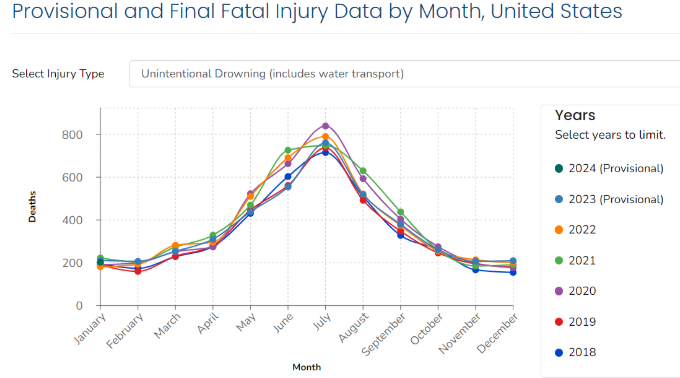
Drowning during the school year rarely occurs because a child decided to go for an intentional, supervised swim. Instead, accidents happen during routine daily activities when adult supervision is dropped or focused elsewhere.
Suburban neighborhoods and parkways throughout St. Louis Park and surrounding West Metro communities feature retention ponds, drainage basins, and natural wetlands. These areas sit close to residential streets, playgrounds, and elementary schools.
When kids walk home from school, ride bikes with friends, or play outside during cooler fall evenings, these unfenced water features pose silent risks. Unlike public pools, retention ponds have steep banks, zero underwater visibility, muddy bottoms, and no lifeguards. A sudden slip off a damp bank while chasing a ball can pull a fully clothed child into cold water instantly.
While Minnesota summers are short, autumn can bring unexpected warm spells that keep home backyard pools open late into September or October.
The hazard stems from shifting family routines. Parents hosting a backyard fall gathering or doing yard work naturally drop active pool supervision because no one is planning to swim. A curious toddler playing near the pool deck can fall into an open, unmonitored pool in seconds.

The transition into autumn introduces specific physical challenges around water:
The school year brings new classmates and invitations to friends' houses after school. Parents often drop off their children expecting routine indoor play, but water safety precautions vary from house to house.
A host parent might assume children are safely playing video games inside while the kids wander out toward a backyard hot tub, open pool, or neighborhood pond.
Growing up in Minnesota means living alongside water. Learning how to swim is not just a recreational summer sport like soccer or tee-ball; it is a fundamental, life-saving skill.
Data from a CDC Vital Signs report notes that drowning remains the leading cause of accidental injury death for children ages 1 through 4 nationwide. Research demonstrates that participating in formal, structured swim instruction reduces drowning risk in young children by up to 88%.
Structured, year-round practice makes all the difference. Casual summer splashing helps kids feel comfortable in the water, but it rarely instills automatic self-rescue reactions.
When families pause swim instruction in September, kids experience skill regression over the fall and winter months. Breath control weakens, floating habits fade, and physical stamina drops. Year-round indoor lessons provide crucial benefits:
Protecting your children as school routines pick up involves a few straightforward safety practices:
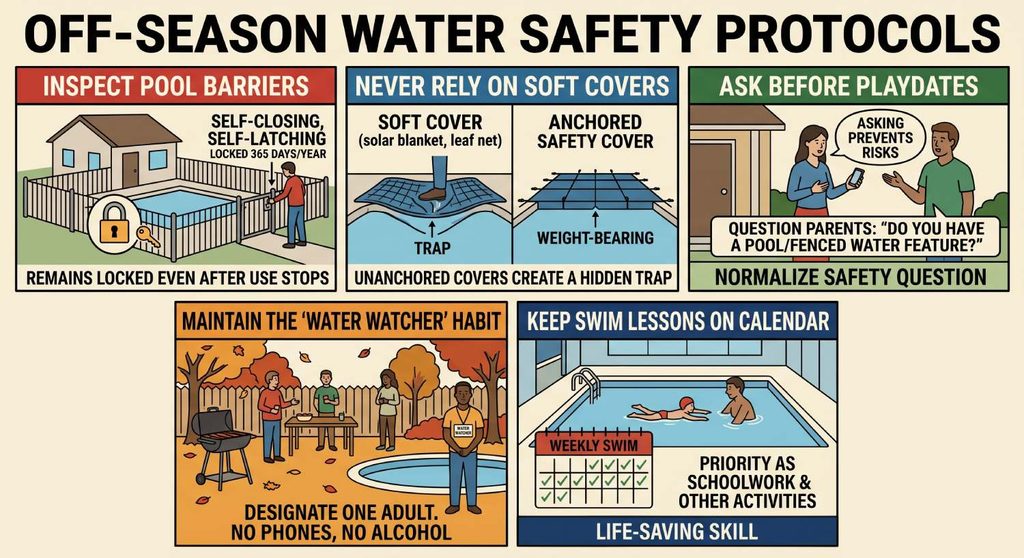
Water safety is an everyday priority in Minnesota. By recognizing off-season risks and supporting continuous skill development, you give your child the confidence and ability to stay safe around water in every season.
If you want to build strong, life-saving water skills for your child that last through every season, Hudson Valley Swim - St. Louis Park is here to help. Our experienced instructors offer year-round indoor swim lessons in a warm, supportive pool environment inside LA Fitness.
Ready to get started? Check out class schedules and program options on our Pricing & Schedule page, or call our local team directly at (612) 445-9995.
Location:
Hudson Valley Swim® - St. Louis Park
LA Fitness
3555 MN-100
St. Louis Park, MN 55416

Experience Hudson Valley Swim! Explore our program, and find the perfect fit for your swimmer!
Offer available for new students only.