The first time your child swims across the pool without help is a moment worth celebrating. After watching them build confidence, practice, and work through challenges, you can see how far they’ve come.
It can also raise a reasonable question: do they still need swim lessons?
At Hudson Valley Swim Piscataway, we encourage parents to celebrate that accomplishment and talk with their instructor about what comes next. Swimming across the pool shows progress, but distance is only one part of learning to swim. How your child breathes, stays in control, rests in the water, and repeats their skills also matters.
Understanding those pieces can help you decide what continued lessons could offer your child.
Crossing the pool shows that your child can swim that distance in that setting. That is a great achievement!
To understand their progress more fully, it helps to look at how they complete the swim.
For example:
You don’t need to figure this out on your own. Your child’s instructor can explain what they are doing well and which areas still need practice.
One child might make it across while still finding it difficult to breathe and keep moving. Another may swim the same distance more smoothly and consistently. Both have made progress, but what they work on next may be different.
When parents picture swimming ability, moving through the water often comes to mind first. But being comfortable and capable in the pool also involves skills that don’t take a child from one side to the other.
Floating and treading water are examples. They involve staying in place rather than continuing to swim forward.
Our children’s swim lessons include front and back floating, coordinated arm and leg movements, short-distance independent swimming, and beginning treading water in the Starfish level.
These activities have a purpose even when your child can already swim across the pool. They give children practice with different ways to support themselves and control their movements in the water.
Ask your instructor how your child is doing with these skills alongside their forward swimming.
A child may be able to swim a short distance while holding their breath or stopping to lift their head. Learning to breathe while keeping their movements going is another step.
That takes practice. Children are learning how to bring their body position, arms, legs, and breathing together.
At Hudson Valley Swim Piscataway, our intermediate Lionfish classes include freestyle with side breathing. In our Youth swim lessons, Marlin swimmers begin working on freestyle with side breathing, while Barracuda swimmers develop continuous side breathing.
For a parent, improvement might look like fewer stops, smoother swimming, or less interruption when your child takes a breath.
They may be swimming the same distance as before, but doing it with more comfort and control. Continued lessons give them time to practice those changes with their instructor’s help.
It’s exciting when your child learns a new skill! Being able to repeat it consistently is another important part of learning.
Your child might swim across the pool during one lesson and find it difficult the following week. Their concentration, comfort, and the amount of help they receive can all affect how an activity goes.
Regular practice helps the instructor see what is becoming familiar and what still needs attention.
Useful questions include:
You don’t need to test your child or ask them to prove their ability during family pool time. Their swim lessons give the instructor opportunities to watch, offer feedback, and help them keep improving.
Swimming farther is a great goal, but staying in control throughout the swim is just as important.
A child may start with smooth, coordinated movements, then find it harder to keep them going as they get tired. Lessons give them opportunities to build endurance gradually while continuing to practice how they swim.
Our advanced Kingfish and Shark classes include improving stroke technique and swimming longer distances. Shark swimmers also work on turns as part of their more advanced instruction.
That does not mean every child needs to pursue competitive swimming. Being able to swim longer with more controlled movements can be worthwhile for children who simply enjoy spending time in the pool.
Your instructor can help explain which goals fit your child’s current abilities and interests.
If you have a younger child who is not yet swimming across the pool, the same idea applies: each milestone gives them something to build on.
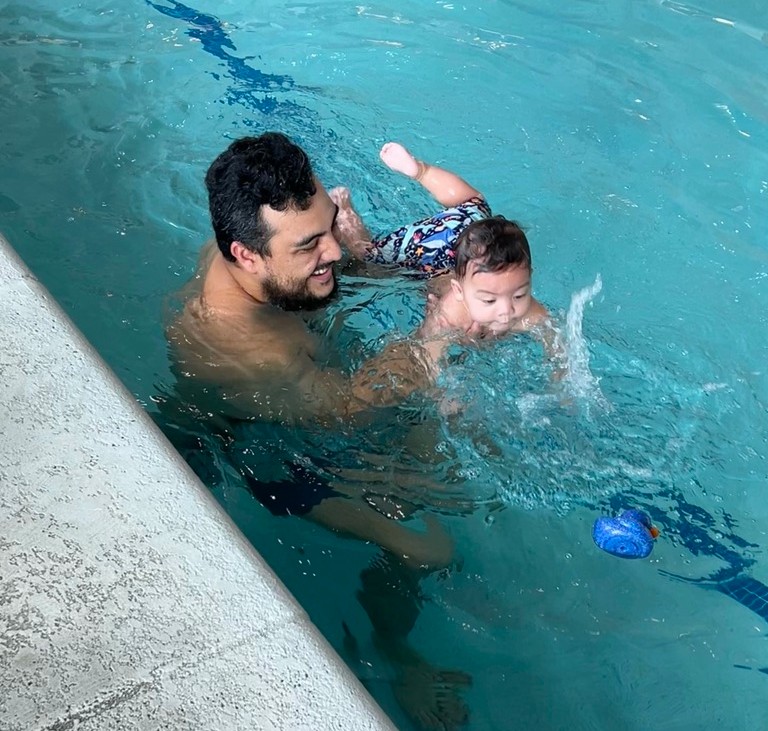
Through our Infant & Toddler swim lessons, young children begin their swimming experience with a parent or caregiver participating in the water with them.
As children grow and move into age-appropriate programs, their instruction builds on what they can do and how comfortable they feel.
Joining in more willingly, putting their face in the water, floating with less help, and learning to move their arms and legs together can all be meaningful steps.
Independent swimming is an exciting milestone along the way. It gives the instructor something to build on as your child continues learning.
For Piscataway families, swimming might include time at a backyard pool, a community pool, or summer trips to the Jersey Shore. Each setting can bring different challenges.
A familiar lesson pool is different from the ocean or even an unfamiliar pool. Water depth, visibility, waves, currents, and the distance to a place to get out can change the experience.
Continued instruction can help children develop their swimming ability, but no lesson milestone makes a child safe in every situation.
Children still need appropriate, active adult supervision around water, regardless of how far or how well they can swim. Their abilities should always be considered alongside the setting, conditions, and other necessary safety measures.
As your child becomes more confident, keep celebrating their progress while making careful decisions about where and how they swim.
Rather than deciding based only on distance, ask your instructor for a clear picture of your child’s progress.
Three questions can help:
You deserve to understand the purpose of your child’s lessons. If the next steps feel unclear, our Piscataway team can talk through their progress and explain what the instructor is focusing on.
After a big accomplishment, children may be eager to learn more. Others may feel that they have reached the goal they were working toward.
Keep the conversation positive. Recognize what they have achieved, then ask what they enjoy about lessons or would like to feel more comfortable doing.
You might say, “You worked hard to swim that distance. Great job! Let’s ask your instructor what you’re going to practice next.”
Keeping the focus on their progress gives them a part in the conversation and something to look forward to.
At Hudson Valley Swim Piscataway, we want children to feel encouraged as their abilities grow. Explore our children’s swim lessons or Youth swim lessons, and talk with our team about your child’s next steps.
Swimming across the pool is a wonderful accomplishment. With a clearer understanding of their skills and goals, you can help your child make the most of what comes next.
Enroll once and keep swimming!
Our continuous enrollment model means you enroll once, and your swimmer stays enrolled in their weekly lesson month after month—no need to re-enroll!
Build water safety skills, confidence, and a lifelong love of swimming with consistent, ongoing lessons.
SIGN UP NOW